


Credit Card IFSC Code
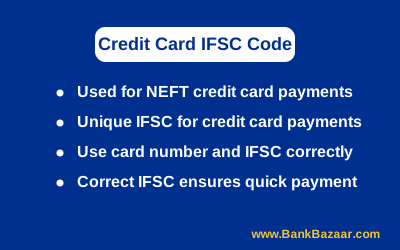
A credit card IFSC (Indian Financial System Code) allows an individual to use National Electronic Funds Transfer (NEFT) to pay for his credit card bills. The online payment involving a credit card IFSC uses a distinct platform provided by the Reserve Bank of India (RBI). In addition to the multiple payment methods a credit card user can choose, NEFT is one of the most popular and easy methods for fund transfers in India.

Moreover, a credit card IFSC code allows NEFT payments for credit cards only since it is different from the IFSC code used by a bank/branch to support online fund transfer. The credit card IFSC code allows payments towards credit cards without the need of being a savings/current account holder with the same bank.
Credit Card IFSC Code for Top Banks
Credit Card IFSC Code for few of the top banks in India are listed below
Bank Name | Credit Card IFSC Code | Branch |
HDFC0000128 | Chennai | |
SBIN00CARDS | Mumbai | |
CITI0000003 | Chennai | |
INDB0000018 | Mumbai | |
SYNB0002915 | Bangalore | |
UTIB0000400 | Mumbai | |
YESB0CMSNOC | Mumbai | |
HSBC0400002 | Mumbai | |
IDBI BANK | IBKL0NEFT01 | Mumbai |
Punjab National Bank | PUNB0112000 | New Delhi |
What is a Credit Card IFSC Code?
A Credit Card IFSC Code is a unique 11-character alphanumeric code assigned to the bank’s credit card division for processing NEFT/RTGS payments. Unlike a standard branch IFSC code, this one is specific to credit card bill payments. It helps route funds from your savings or current account directly to your credit card account when paying bills online.
How Does the Credit Card IFSC Code Work
The credit card IFSC allows an online banking or NEFT user of a particular bank to add a credit card of another bank as a beneficiary for NEFT transactions. By using the credit card number as the account number, name on the credit card as the account holder, the credit card IFSC allows individuals to use NEFT as the preferred mode for credit card bill payments.
Credit Card IFSC Code Rules and Regulations
Rules and Regulations of Few Credit Card Banks IFSC Code.
HDFC Bank Credit Card IFSC Code - Rules and Regulations
- HDFC Bank accepts credit card bill payments through NEFT from over 49 other banks and branches who are part of NEFT network.
- There is no charge for using the HDFC Bank's credit card IFSC code in the NEFT process for paying the HDFC credit card bill.
- Customers are advised to check the list of NEFT-enabled banks before initiating an online fund transfer. HDFC Bank's website has a list of banks who are a part of the NEFT network.
- While initiating the online fund transfer to pay for an HDFC credit card bill, customers are advised to ensure the accuracy while entering the name on the card, card number, transaction amount, IFSC, and other details.
- Once the bill is paid, the card owner can choose to make a note of the receipt number which will be displayed on the screen. Additionally, the acknowledgement will also indicate if the payment has been successful or if it resulted in a failure.
- Based on whether you have registered your email ID and mobile number with HDFC Bank, an email and text confirmation of the receipt of payment will also be sent out.
- Once the payment has gone through successfully, it will take two working days for the fund to reflect in the credit card account.
- HDFC Bank provides multiple payment methods for paying the credit card bills
- The bank can be contacted through telephone and emails for any issues relating to online credit card payments. Moreover, customers can also refer to the official HDFC Bank's website to obtain more information on the extensive range of banking and financial products and services.
State Bank of India Credit Card IFSC Code - Rules and Regulations
- State Bank of India is part of the NEFT network in India which accepts NEFT transactions for credit card bill payments. In order to pay the due bill for an SBI credit card, an individual can list the card for NEFT fund transfers.
- In order to pay the SBI credit card bill, the credit card IFSC SBIN00CARDS is needed to be used at the IFSC section while the credit card acts as the account number and the name on the card is considered to be the account name.
- Once the NEFT transfer is successful, SBI takes 3 working hours to reflect the changes on the credit card account.
- There is no limit on the maximum amount an individual can transfer to his credit card account to settle the bill. However, depending on the bank from where the transaction is being initiated, may attract a fee based on their terms and conditions.
Citibank Credit Card IFSC Code - Rules and Regulations
- The Citibank credit card holders can use a non-Citibank account to pay the credit card bills through NEFT.
- The Citibank credit card IFSC code CITI0000003 can be used as the IFSC while adding a beneficiary on the NEFT section. The name as it appears on the Citibank credit card needs to enter as the payee name while the card number functions as the account number.
- The customers are advised to initiate the transfer of funds before 05:30 p.m. on weekdays and working Saturdays to take advantage of the same day fund settlement.
- If the fund transfer is initiated on a non-working day, the credit settlement will be moved to the next working day.
- The bank from where the funds are being transferred may levy a fee for NEFT service whereas Citibank doesn't charge anything for receiving funds through NEFT for a credit card account.
- Once the transfer completes, Citibank will send out a confirmation to the registered mobile number and the e-mail address of the credit card holder.
- Citibank doesn't allow NEFT bill payments on Citibank World Money Card, Diners Club NRI Card, and International Credit Card since they are designed to accept payments from NRE/NRO accounts only.
- The Citibank customers who are facing issues while performing a NEFT transfer for their credit card can contact the bank by telephone or email to get help from their customer service team.
IndusInd Bank Credit Card IFSC Code - Rules and Regulations
- The IndusInd credit card holders who don't have access to a savings account can use any bank's account to use the NEFT service for credit card bill payments.
- The IndusInd credit card can be added as a NEFT beneficiary on most of the bank's online banking section.
- IndusInd Bank also allows certain customers to use the IFSC INDB0000018 for carrying out IMPS fund transfers.
- In order to use the IndusInd credit card for NEFT bill payment facility, the card number needs to be used as the bank account number, the name of the card act as the account number while the IFSC ensures accurate and fast fund transfers.
- The IndusInd credit card customers are advised to initiate the fund transfer at least two before the bill due to date to avoid a late payment fee.
Syndicate Bank Credit Card IFSC Code - Rules and Regulations
- Syndicate Bank credit card holders can make use of the credit card IFSC to list the card as one of the beneficiaries for the NEFT fund transfer method. The convenience of credit card bill payment from any bank account makes it easier to avoid late payment charges while allowing flexibility to the customer.
- The method for adding a Syndicate Bank credit card for NEFT is similar to any other bank where the beneficiary's name is the card holder's name and the card number is the account number. However, a remitter needs to be careful while entering the credit card IFSC code to ensure accuracy.
- The IFSC SYNB0002915 is required to be used for making any NEFT payment to a Syndicate Bank's credit card.
Axis Bank Credit Card IFSC Code - Rules and Regulations
- The Axis Bank credit card users can use the specific credit card IFSC to pay their credit card bills through NEFT. In addition to various other bill payment methods, NEFT is one of the most cost-effective, reliable, and popular method of fund transfer in India.
- By using the Axis Bank's credit card number, name on the card, and the credit card IFSC code, the credit card can be added as a beneficiary for NEFT transaction from any other bank which is NEFT-enabled.
- Axis Bank also provides customised bill payment experience which allows a customer to choose and modify the payment frequency based on his/her requirements.
- The Axis Bank's credit card holders can also utilise the bank's availability at the National Automated Clearing House (NACH) for paying credit card bills from other bank accounts.
- Additionally, the bank also allows credit card bill payments through IMPS.
Yes Bank Credit Card IFSC Code - Rules and Regulations
- Yes Bank allows the credit card customers to opt for the easy way of NEFT to pay credit card bills.
- From Yes Bank's Net Banking, Standing Instructions, ATM Fund Transfer, Billdesk - Payment Gateway, Cash/Cheque Payment to NEFT, the customers as well as account holders can use any of the methods to pay the Yes Bank's credit card bill.
- The customers are advised to follow the common method for adding a beneficiary for NEFT, however, they need to use the specific credit card IFSC code provided by the bank to ensure quick bill settlements for their credit cards.
- The NEFT payments are processed faster which helps customers in obtaining a quick transaction receipt for the transaction.
HSBC Credit Card IFSC Code - Rules and Regulations
- HSBC Bank provides an extensive range of credit card bill payment methods for their credit card holders.
- Known for being one of the most convenient and cost-effective methods for transfer of funds, NEFT is one of the payment methods that can be used for paying the HSBC credit card bills.
- A credit card holder can use any of the other bank's account that allows NEFT to make payment for their credit card bills.
- In accordance with the applicable rules and regulations on NEFT, HSBC caters to the customer's requirements through a dedicated team of customer support executives.
- A customer, as well as individual, can contact the bank through a phone call or e-mail to get more details on any of the products and services offered by the bank. The HSBC website can be accessed to obtain information pertaining to online transfers, credit cards, savings account, and various other
IDBI Bank Credit Card IFSC Code - Rules and Regulations
- The IDBI Bank's credit card IFSC code allows NEFT payments to be acceptable for credit card bills.
- The bank encourages customers to make use of any NEFT-enabled bank account to make credit card bill payments.
- The IDBI credit card IFSC score enables NEFT facility for the credit card holders who do not have a savings account at IDBI Bank.
- The credit card holders can use the basic details available on the card along with the credit card IFSC IBKL0NEFT01 to register the card for bill payments through NEFT transactions.
PNB Credit Card IFSC Code - Rules and Regulations
- To offer an enhanced banking experience to the customer, PNB allows credit card holders to pay their bills through NEFT transactions from other banks.
- The credit card customers are advised to check for the availability of NEFT option with their bank before initiating any transfer.
- The bank's website offers step-by-step guidelines to add a credit card for NEFT bill payments. The useful guidelines can help a PNB credit card customer to add the credit card details for NEFT bill payments.
- PNB appeals to the customer to use the correct credit card IFSC in order to ensure a speedy settlement of funds.
- Considering the fact that NEFT has chances of settlement on the next day due to effective business hours, it is advisable to make the payment at least two days before the bill due date which will help in avoiding any late payment fee.
Different Types of IFSC Codes Used in Credit Card Transactions
When it comes to transferring money from one account to the other, it becomes essential for each branch to have their own IFSC as each bank will have more than thousands of retail and commercial accounts. However, the number of credit cards issued by a bank (not a branch) is fairly less when it is compared to the number of debit cards the same bank might have issued. The credit card IFSC codes are always linked to the headquarter of the banks allowing a nationwide application of the code.
Application of IFSC in Credit Card Payments
Whether a fund transfer is initiated by NEFT, Real-Time Gross Settlement (RTGS), or Immediate Payment Service (IMPS), the person who is initiative the transfer (known as the remitter/originator) is required to provide certain details of the bank and the person receiving the funds (also known as beneficiary/receiver). Along with the details of the account holder, account number, bank name, and the account type, the originators or the card holders are also required to enter the IFSC code of the branch where the funds are being sent. The IFSC codes help RBI and other governing bodies in identifying the accurate details of the branches involved in the transfer of funds. As a particular IFSC cannot belong to more than one bank/branch, the credit card IFSC is free from such restrictions since a bank with thousands or more branches is still entitled to only one credit card IFSC code. All the branches of the same bank will use the same credit card IFSC code to receive payments on the credit cards for their customers.
When to Use Credit Card IFSC Code
The IFSC for a branch is mainly used for NEFT, RTGS, IMPS and similar online transactions where an individual sends a certain amount of money from his/her bank account to another bank account. However, when an individual has to settle the credit card bill, he/she is provided with various types of options ranging from Net Banking, Payment Gateways, Mobile Banking, ATM Fund Transfer, Standing Instructions, Cheque to Cash payment at a branch, etc. But, when the credit card holders are required to pay the bill from another bank account or when a lender decides to send the funds by online transfer, NEFT turns out to be the most convenient, cost-effective, and flexible payment method. In order to send money to a credit card, a bank will need the following details from the sender:
- Name as it appears on the credit card
- Account number (credit card number)
- Bank's name
- Account type
- IFSC code
- Address of the branch (verified through IFSC).
Difference Between Credit Card IFSC Code and Branch IFSC Code
In order to understand the difference between credit card IFSC and branch IFSC, it is essential to understand their functions and how they are being utilised for online transactions in India. In order to avoid conflicts which may arise due to online fund transfers encountering errors and resulting in funds getting credited to a wrong account, risk of transaction failures, etc. the government of India introduced the 11 digits IFSC system which is similar to the system used in the Society for Worldwide Interbank Financial Telecommunication (SWIFT). The IFSC functions as an identifier for each of the banks and their branches in India. However, a bank cannot have more than one credit card IFSC since this type of IFSC is used only for receiving payments for credit cards unlike the exchange of funds being carried out on branch IFSCs.
Important Facts About Credit Card IFSC Code
- IFSC was introduced by the government of India to act as an identifier based the system used by SWIFT.
- RBI regulates IFSC and all other banking/financing rules and regulations in India.
- RBI can amend the existing IFSC system or decide to remove it.
- Banks cannot assign IFSC by themselves.
- Each bank/branch has an IFSC assigned to it, provided they offer online fund transfer facility to their customers
- IFSC is an 11 digits alphanumeric code with first four letters indicating the bank name and the last six digits representing the branch code along with the fifth code which is zero by default.
- The banks and their branches use the same credit card IFSC code throughout the nation to receive payments on the credit cards issued by them.
- It is mandatory for the banks to print the IFSC code of the specific branch on the passbook and account statement for all the customers.
- Both the credit card IFSC and the branch IFSC are subject to the common rules and regulations pertaining to cut-off timing, batch processing system, and other guidelines as specified by RBI.
How to Find the Credit Card IFSC Code
Though there are plenty of websites which will provide you with IFSC information which includes the name of the bank, address, etc, it is recommended to cross-check the validity of the IFSC code with the bank itself before initiating any transactions. The allotment of IFSC is carried out in a serial order as new branches get added to the bank.
If you already have the passbook or the bank statement, you will need to locate the 11 digits alphanumeric ID which may look like ABCD0123456. Based on the name of your bank, you should notice familiar characters in the first four letter.
FAQs on Credit Card IFSC Code
1.Where can I find the credit card IFSC number for my card?
The credit card IFSC is provided by the credit card issuing bank. You can either get in touch with the bank directly or visit the bank’s official website to find the credit card IFSC.
2.What happens if I use the wrong IFSC code for a credit card payment?
If you enter the wrong IFSC code, your payment may fail, be delayed, or be credited to the wrong account. In most cases, the amount is reversed to your bank account, but it may take a few working days. Always verify the correct credit card IFSC code before initiating NEFT.
3.Do all banks assign unique IFSC codes to credit card departments?
Yes, most major banks in India assign a dedicated IFSC code to their credit card department for NEFT/RTGS payments. This helps route transactions accurately and prevents confusion with regular savings or current account IFSC codes.
4.Is there a universal IFSC code for credit card bill payment per bank?
Yes, each bank typically has one universal IFSC code used across India for credit card NEFT payments. For example, HDFC Bank uses HDFC0000128, and ICICI Bank uses ICIC0000103 for all credit card bill payments. It’s centralized, not branch-specific.
5.How long does it take for a credit card payment via IFSC code to reflect?
Credit card payments made via NEFT using the correct IFSC code generally reflect within 2 to 4 working hours, depending on the bank's processing time. Payments made after business hours or on holidays may reflect on the next working day.
6.What does credit card IFSC do?
Credit card IFSC is required for adding the credit card as the NEFT beneficiary of a savings account. The IFSC identifies the beneficiary bank and directs the funds to that particular bank for settlement.
7.What are the charges for paying a credit card bill through NEFT?
Though your credit card issuing bank won’t charge any fee for receiving funds from a savings account of another bank, the bank from where the transaction is being initiative will levy a fee based on their terms and conditions for NEFT. All banks follow the RBI guidelines for levying a fee on transactions concerning online transfers, however, a bank providing additional benefits and flexibility on the NEFT transactions may charge an additional fee.
8.How soon will the funds be credited to my credit card account?
Depending on when the NEFT transfer is initiated, it takes around 2 working hours for the fund to reflect on the credit card account. The fund settlement is subject to RBI cut off time and the NEFT availability.
9.Is there a receipt for sending payments to a credit card?
Yes, the bank from where the fund is being transferred, they will send a transaction confirmation receipt to your registered mobile number and/or email address.
10.Do credit cards have an IFSC code?
Yes, credit cards have an IFSC code. The IFSC code will be provided by the bank issuing the card. You can visit the official website of the bank or contact the bank to get the IFSC code. The IFSC code is needed to add the credit card as a beneficiary in order to make NEFT payments.
11.What is the credit card IFSC code for ICICI Bank?
The IFSC code for credit cards issued by ICICI Bank is ICIC0000103.
12.What is the credit card IFSC code for Kotak Mahindra Bank?
The IFSC code for credit cards issued by Kotak Mahindra Bank is KKBK0000958.
13.What is the credit card IFSC code for Canara Bank?
The IFSC code for credit cards issued by is CNRB0001912.

Disclaimer
Credit Card:
Credit Score:
Personal Loan:
Home Loan:
Fixed Deposit:


Copyright © 2026 BankBazaar.com.