


Two-Wheeler Insurance Details
If you own a two-wheeler in India, it is mandatory to have a two-wheeler insurance. As per the Motor Vehicles Act, 1988, every two-wheeler owner is required to purchase at least a third-party insurance policy, before the vehicle is used on the roads.
Riding a two-wheeler without an insurance policy will attract penalty and legal consequences (from Rs.2,000 to up to 3 months imprisonment). Having an insurance policy not only helps you avoid fines, but also provides financial security liabilities arising from injury, death, or property damage caused to a third party due to an accident involving the insured two-wheeler.
Read on to know more about some of best two-wheeler plans offered in India and other related details.

Two-Wheeler Insurers in India in 2026
Some of the two-wheeler insurers in India are mentioned below:
Insurance Company | Cashless Garages |
HDFC Ergo General Insurance | More than 2,300 |
More than 11,000 | |
Shriram General Insurance | More than 2,000 |
More than 4,300 | |
More than 9,000 | |
More than 4,300 | |
More than 4,700 | |
Cholamandalam MS General Insurance | More than 8,500 |
United India Insurance Company | More than 3,100 |
Royal Sundaram General Insurance | More than 4,600 |
Bajaj General Insurance | More than 4,000 |
ICICI Lombard General Insurance | More than 6,900 |
Bharti AXA General Insurance | More than 5,200 |
ACKO General Insurance | More than 2,000 |
Zurich Kotak General Insurance | More than 5,700 |
Why is Two-Wheeler Insurance Essential in India?
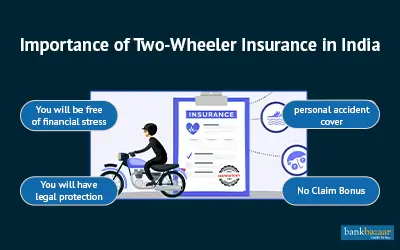
Two-wheeler insurance is a mandatory criterion to legally drive on Indian roads. Some of the reasons explaining why it is important are given below:
- Avoid Financial Stress: In case your vehicle is damaged or stolen, you won’t have to worry about the costs incurred in fixing it or replacing it as the insurance company will take care of it.
- Theft Coverage: Some two-wheeler insurance policies also provide theft coverage. This ensures financial protection if your scooter or bike is stolen. In case your two-wheeler is not recovered after being reported stolen, the insurance company will compensate you as per the Insured Declared Value (IDV) of the vehicle.
- Legal Protection: Considering the fact that it is compulsory to have an insurance policy in place when riding on Indian roads, carrying a copy of your insurance policy will ensure that you will be legally protected against paying fines or penalties.
- Personal Accident Cover: If you are insured, the insurance company will provide cover (up to a certain amount) in case you suffer total permanent disability. In case the policyholder passes away, your family will receive the sum assured from the insurance company.
- No Claim Bonus: You will be able to enjoy benefits like No Claim Bonus (NCB).
Types of Bike Insurance
There are two kinds of two-wheeler insurance policies, viz. comprehensive plans and liability-only plans.
Third-Party Liability Insurance/Liability-only insurance | Comprehensive Insurance |
A third-party liability insurance plan provides coverage against losses or damage caused by the insured two-wheeler to a third party or his/her property. Two-wheeler Owner may also receive coverage in the form of a personal accident cover, but no coverage will be provided for the theft or any damage. | A comprehensive two-wheeler insurance policy, although not mandatory, is highly recommended for all bikes. This insurance plan offers extensive coverage to the bike and its owner. It also protects policyholders from legal liabilities to third parties in an accident |
Inclusions of Two-Wheeler Insurance
The policy document will cover all the inclusions and exclusions of your motorcycle insurance plan. The following are the inclusions of a two-wheeler insurance policy:
Coverage | Details |
Natural Events | Covers damages caused by natural calamities such as fires, earthquakes, floods, hurricanes, storms, lightning, hailstorms, cyclones & rockslides |
Man-Made Events | Covers loss or damage due to burglary, strikes & riots, including damages during transit by road, rail, air or waterways |
Legal Third-Party Liability | Covers legal losses due to third-party injuries, property damage or death caused by the insured two-wheeler |
Personal Accident Cover | Covers the owner-driver up to ₹15 lakh for permanent or temporary disability, loss of limbs or total/partial disability due to an accident |
Theft Coverage | If the stolen vehicle is not recovered, the insurer compensates based on the Insured Declared Value (IDV) after deducting applicable depreciation |
Note: The inclusions offered with two-wheeler insurance vary depending on the insurance company and the policy variant. It is advisable to read the policy document carefully before purchasing it.
Exclusions of Two-Wheeler Insurance
The following are the general exclusions of a two wheeler insurance policy:
- Damages incurred by normal wear and tear of the two-wheeler.
- Losses incurred due to electrical or mechanical breakdowns.
- Damage to tubes and tires.
- Consequential losses or depreciation from regular use of the vehicle.
- Losses incurred by the vehicle when it was being used for illegal purposes.
- Damages or losses incurred by the vehicle when it was being used by someone who does not have a valid driving license.
- Damages or losses incurred by the vehicle when the driver was using the vehicle under the influence of drugs or alcohol.
- Damages or losses incurred by the vehicle due to mutiny, war, or from nuclear risk.
Depending on the type of coverage you buy, a bike insurance plan offers protection against liabilities that result from injuries to the rider, the pillion passenger, as well as third parties. It is crucial to evaluate plans offered by different insurers in order to choose the most affordable two-wheeler insurance policy with sufficient coverage.
Bike Insurance Premium Calculator
A lot of insurance companies offer online tools like a two-wheeler insurance premium calculator. Using this makes it easy for you to estimate your bike’s premium. As long as your vehicle is registered with the Regional Transport Office (RTO), you can quickly calculate the applicable premium online using these tools.
Follow the process given below to calculate the amount of your insurance premium:
- You need to enter details regarding your two-wheeler, such as the number of the vehicle, the make, the model, the variant, etc.
- The registration details of the two-wheeler must be entered, such as the RTO location where the vehicle was registered.
- You will have to provide information related to your existing policy. You will also be required to mention your claim history and policy expiry date.
- Choose between third-party insurance and comprehensive insurance
- Click on ‘Get Quotes’.
Two-Wheeler Insurance Add-on Covers
The majority of insurance providers bundle extra coverage with their bike insurance policies. Each add-on cover has its own advantages, giving you the freedom to choose only those that will meet your specific insurance needs.
1. Personal Accident Cover for PillionCovers the pillion rider against accidental death, permanent or partial disability in case of an accident, reducing your financial liability significantly.
2. Roadside AssistanceProvides emergency support if your bike breaks down or faces a mechanical issue, including on-the-spot repairs, free towing and other assistance – especially useful in remote areas.
3. Accessories CoverCovers the cost of repairing or replacing electrical and non-electrical accessories of the two-wheeler if they are damaged in an accident.
4. Consumables CoverCovers expenses on consumable items such as nuts, bolts, engine oil, etc., which are not included under a basic two-wheeler insurance policy.
5. Zero Depreciation CoverRemoves the depreciation deduction from your claim settlement, ensuring you receive the full claim amount without any deductions on parts.
6. Daily Cash AllowanceProvides a fixed daily cash amount to cover travel expenses while your bike is undergoing repairs at a garage after a serious accident.
7. Engine CoverCovers repair expenses for damage to the engine or ancillary circuit caused by flooding or waterlogging, saving you from high out-of-pocket repair costs.
8. Return to Invoice CoverReimburses the original invoice value of your two-wheeler in case of theft or total loss due to natural calamities, covering the depreciation gap.
Claim Settlement Process for Two-Wheeler Insurance
The procedure mentioned below will help you with the claim settlement process for two-wheeler insurance through reimbursement claim and cashless claim:
Reimbursement Claim Settlement Process
Step 1 - File a claim with your insurance company.
Step 2 - Complete the claim form. Send the completed form and necessary documents to the insurance company.
Step 3 - The insurance company will conduct a survey to determine the cost of repairs and will inform you about the results.
Step 4 - After the survey is completed, you can get your vehicle repaired at a garage that is not registered with your insurance company.
Step 5 - The insurance company will conduct another inspection after the repair of your vehicle is done.
Step 6 - Clear the bill at the garage by paying all the fees.
Step 7 - Send the insurer all the invoices, payment receipts, and ‘Proof of Release’.
Step 8 - The claim amount will be paid to you once it has been accepted.
Cashless Claim Settlement Process
Step 1: You need to first inform your insurance company about your two-wheeler's accident and file an FIR.
Step 2: Your insurance company will conduct a survey regarding the accident.
Step 3: Complete the claim form, then submit it with all necessary supporting documents to your insurance company.
Step 4: After the insurance company approves your request, your vehicle will get repaired at a garage associated with your insurance company.
Step 5: After repairs, your insurance will pay the garage directly for the repair costs.
Note: Deductibles and other costs that are not covered must be met by you (if any).
Documents Needed for Filing Bike Insurance Claim
The documents needed for filing bike insurance claim are mentioned below
- Completed and signed claim form
- Valid copy of Registration Certificate (RC)
- Valid driving license
- Repair invoice and original payment receipt
- Valid two-wheeler insurance policy
- Proof of release (in the event that a reimbursement claim is settled)
- Accident, theft, and third-party liability police reports
Note: The list of documents given above are in general and you may be required to submit additional documents depending on your insurance provider.
Process to Purchase Two-Wheeler Insurance Online
The procedure that must be followed to purchase a two-wheeler insurance cover online is mentioned below:
Step 1 - Visit the official website of the insurer.
Step 2 - Select bike insurance or two-wheeler insurance.
Step 3 - Enter the vehicle number.
Step 4 - Choose ‘Get Quote’.
Step 5 - The vehicle details will be displayed.
Step 6 - Choose the add-on covers that are needed and the type of insurance cover to get the quote.
Step 7 - Make the payment to purchase bike insurance cover.
Factors to Keep in Mind While Choosing Bike Insurance
Below are a few factors that one should keep in mind while choosing a bike insurance -
Simplicity of Transferring No Claim Bonus: In case you purchase a new two-wheeler, transferring the No Claim Bonus is a process that has been made relatively simple by insurance companies. The bonus is transferred in the name of the owner or the driver of the vehicle, and not the vehicle itself.
The No Claim Bonus is given to drivers and vehicle owners because of the safe driving practices followed by them and not making any claims in the previous year(s).
Optional Covers: Optional covers include increased cover for accessories and spare parts, personal accident cover to protect pillion riders, zero depreciation cover, etc. You can purchase these covers at a nominal fee and increase the level of protection for your vehicle. These covers come in handy in times of unfortunate or unforeseen events.
Discounts: Insurance companies approved by the Insurance Regulatory and Development Authority of India (IRDAI) offer discounts for factors such as membership in recognised automobile associations, vehicles fitted with approved safety devices like anti-theft systems, and a good riding record through No Claim Bonus benefits.
Online Purchase and Renewal: Bike insurance plans can be purchased and renewed online with relative ease. Many insurance companies also have mobile apps that make it convenient for customers to purchase or renew their policies. Considering the fact that all details of the policy are stored in the database, the renewal process is relatively simple and happens very quickly.
Customer Care: When picking an insurer, one of the important things to look for is a team that provides client service around-the-clock. The term spontaneous customer assistance’ refers to their willingness to help you whenever you need it with all of your questions and claim resolutions.
KYC Documents Needed to Buy/Renew Bike Insurance
The KYC documents needed to buy/renew bike insurance are mentioned below -
- Identity proof documents (Passport, Aadhaar card, PAN Card, driving license, Voter ID)
- Address proof (Passport, Aadhaar card, driving license, Voter ID)
Features of Two-Wheeler Insurance
The following are the key features of a two-wheeler insurance policy:
- Bike insurance policies are categorised as motor insurance policies that are part of the general insurance industry.
- Motorcycle insurance plans provide financial coverage against damages incurred by the insured vehicle as well as theft of the vehicle.
- In case your two-wheeler insurance policy has expired, all the damages incurred by your vehicle will have to be borne by you.
- Bike insurance plans offer coverage against natural disasters as well as man-made calamities such as earthquakes, storms, landslides, riots, theft, explosions, strikes, etc.
- In case of the loss or theft of your vehicle, a pre-determined sum assured up to the Insured Declared Value will be provided to you.
- When purchasing a bike insurance policy, you will be required to pay a pre-specified premium to the insurance company over regular intervals of time for a certain period.
- Premium rates are cost-effective and can be negotiated with the insurer at the time of purchasing the policy.
You can choose the kind of coverage you require from liability only and comprehensive two-wheeler insurance plans. The Indian Motor Vehicles Act has made it mandatory for all vehicles to be covered by a liability only policy. It provides coverage against wear and tear of your two-wheeler.
Read more about 6 Benefits of Two Wheeler Insurance Renewal
What are the Consequences of Not Buying Two-Wheeler Insurance?
As per the Motor Vehicles Act 1988, it is mandatory for all two-wheeler owners to have at least a third-party insurance. Some of the consequences of not having a two-wheeler insurance are as follows:
Legal Consequences: Depending on the severity of the offense and the discretion of the authorities, you may have to pay hefty fines for riding a two-wheeler without a two-wheeler insurance policy. You may have to face legal complications, including potential court cases and legal proceedings if you do not have valid two-wheeler insurance.
Financial Consequences: If you don’t have two-wheeler insurance, you will have to bear high repair or replacement costs in case of an accident. You will also miss out on ‘No Claim Bonus’ benefits, leading to higher premiums later. Moreover, you will have to fully bear third-party liabilities (if any); this also includes medical, legal and property damage expenses.
Personal Consequences: If you don’t have two-wheeler insurance, you will have no personal accident or medical coverage. In this case you will have to bear all treatment, repair, and replacement costs yourself in case of an accident. This can lead to heavy financial strain and significant mental stress.
How to Compare and Choose a Two-Wheeler Insurance Policy?
Choosing the right insurance policy is an important decision and involves a lot of research. Here are the few points that can help you understand which policy suits you better and will be helpful:
- Type of Cover: You need to understand what type of cover you need. You can either choose a third-party insurance, which is mandatory by law, or you can choose a comprehensive insurance as it offers wider protection, including damage to your own bike due to accidents, theft, fire, or natural calamities.
- Check the Premium Amount: It is essential that you do not choose a policy just because it is cheap. You need to compare policies of different premium amounts and what facilities they are offering to make the right choice.
- Check the ‘Claim Settlement Ratio’: This ratio helps you understand the number of claims settled by the company. Check out the insurer’s claim settlement ratio, availability of cashless garages, and ease of filing claims online or offline to make an informed decision.
- Check Customer Reviews: It is essential that you check customer ratings and reviews before purchasing a policy. This will give you insights into the insurer’s service quality, claim handling, and overall customer satisfaction.
How to Check Bike Insurance Online?
In order to check details of the bike insurance policy online, you will need to visit the official website of the insurer. You can check the premium as well by entering details of the two-wheeler such as the registration number, year the bike was manufactured, NCB, etc.
How to Renew Bike Insurance Online?
The renewal of your 2-wheeler insurance policy can be done with relative ease online. Insurance companies across the country have their own websites where you can login and renew your bike insurance policy onliine . In fact, many insurers have also tied up with mobile payment vendors to make it more convenient for customers to renew their policies.
Moreover, technologically advanced companies have their own mobile applications that make it very simple for bike owners to purchase and renew their policies online.
Renewal Two-Wheeler Insurance at a Branch
If you want to renew your two-wheeler insurance policy in the old-fashioned way, stop by a branch of the insurance provider. Even while the procedure to renew your bike insurance plan at a branch of the insurance company is straightforward, you will still need to set aside some time to get to the branch.
To complete the application form, you will need to bring your old policy and information on the vehicle with you. If you pay your premium by cash, demand draft, or debit card at a branch office when renewing your insurance coverage, the new policy will be provided to you right away. If you choose to pay the premium with a check, your policy will be mailed to your residential address later after taking some time to clear.
FAQs on Two-Wheeler Insurance
1.What documents do I need to provide to qualify for a two-wheeler insurance discount based on my age and profession?
You must present your PAN Card and an employment or education certificate, respectively, in order to receive discounts based on your age and vocation.
2.What happens if I lose my two-wheeler insurance policy?
If you get in touch with your insurer, they will send you a duplicate policy. For the duplicate copy, you might need to pay a small fee. When making an online purchase, a soft copy of the policy is emailed to the customer's email address. The majority of the time, policy documents are digitally signed, and a colored printout of the same serves as a legally binding hard copy.
3.How can I pay for my two-wheeler insurance?
You can pay the premium for the insurance online using your credit or debit cards. You can also make the payments using net banking. If you are at the company’s office, then you can even pay by cash.
4.What does a two-wheeler insurance endorsement mean?
When referring to two-wheeler insurance, the phrase "endorsement" refers to a contract that serves as written confirmation of any changes to the terms of the policy. This paper serves as reliable evidence of the policy modifications. Typically, there are two categories of endorsements: Premium Bearing and Non-Premium Bearing.
5.What is covered under two-wheeler insurance?
Theft of the vehicle, Damage caused to a vehicle in an accident, Damage caused to a third party or property
6.What if my bike insurance expires?
If the bike insurance has expired, you will need to renew it. You can do so online or by visiting your insurer's office. Generally, you will get a reminder.
7.Can I buy a two-wheeler insurance policy for a vehicle that doesn’t belong to me?
Yes, anyone can buy a two-wheeler insurance policy online, or from an offline source, for a vehicle that may not necessarily be their own.
8.Are modified 2 wheelers eligible for such insurance policies?
When it comes to modified two wheelers, the two-wheeler insurance only applies to vehicles that have been modified for use by handicapped individuals. In such instances, a discount of 50% is applicable on the own-damage premiums, as offered by many Indian insurers.
9.What are the factors that impact the applicable two-wheeler insurance premium amounts?
Type of two-wheeler, Age of the vehicle, City where registered, Coverage period , Any applicable discounts
10.What do you mean by Cashless and Non-cashless/Reimbursement claim?
To identify the best two-wheeler insurance company, compare the premium with the coverage offered. Always evaluate multiple insurers before making a decision. Additionally, check the claim settlement or incurred claim ratio, as it shows how efficiently the insurer settles claims.
11.Can I file a claim for an event that has taken place during the term of the policy, after the policy has expired? Will the claim be valid?
Yes, you will be eligible to make a claim even if your policy has expired, if the damage took place during the policy tenure.
12.Can I avail a no-claim bonus on expired policy?
Yes, you can procure your no-claim bonus on an expired policy within 90 days after your policy lapses. Your no-claim bonus will not be given to you if you do not renew your bike insurance policy within 90 days after it expires.
News on Two-Wheeler Insurance
Hero Dominates Indian Two-Wheeler Market in June 2025
As June 2025 came to an end, Hero MotoCorp continued to hold the top spot on the two-wheeler sales chart. Hero MotoCorp is the world's largest two-wheeler manufacturer, and last month it demonstrated a 10% year-over-year rise in two-wheeler sales. A total of 5,53,963 units have been sold, of which 5,25,136 have been sold domestically. International exports, however, made up 28,827 units. Its sales numbers are steadily increasing, with 7,178 units shipped and 7,665 units registered under VAHAN. As of June 2025, the company had sold 4,29,147 units, of which 3,88,812 were sold domestically. In June 2025, 14,400 EV two-wheelers were sold, down from 15,859 in June 2024, even though domestic sales increased by 10%.

Disclaimer
Credit Card:
Credit Score:
Personal Loan:
Home Loan:
Fixed Deposit:


Copyright © 2026 BankBazaar.com.