


PPF - Public Provident Fund 2026
What is Public Provident Fund (PPF)?
Public Provident Fund (PPF) is a popular long-term savings scheme in India backed by the Government of India. It was launched in 1968 to encourage individuals to build a retirement corpus through small, regular savings. The scheme offers a fixed interest rate, tax-free returns, and is considered a safe investment option due to government backing. One of its key benefits is that both the interest earned and the maturity amount are completely tax-free under Section 80C of the Income Tax Act.
Tenure | 15 years (Can be renewed in blocks of 5 years) |
Interest rate | 7.1% |
Investment Amount | Minimum Rs.500 Maximum Rs.1.5 lakh p.a. |
Maturity Amount | Depends on the investment tenure |
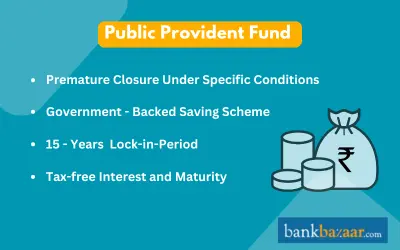
Features of PPF account
The main features of the PPF account are mentioned below:
- Investment Limits: For a PPF, you should have a minimum investment of Rs.500 and your maximum investment is Rs.1.5 lakh for every financial year.
- Tenure of the PPF: The minimum tenure of a PPF is 15 years. This can be extended in sets of 5 years.
- Deposit Frequency: Deposits can be made as a lumpsum once a year or in 12 instalments (maximum).
- Opening Balance: You can open a PPF account with Rs.100 and annual investments over Rs.1.5 lakh will not earn any interest.
- Nomination: As a PPF account holder, you can have a nominee for your account when you open the account or after.
- Mode of deposit: You can make a deposit into the PPF account via cheque, cash, demand draft, or online fund transfer.
- Risk factor: The PPF is backed by the Indian government, and so, it is risk-free and offers guaranteed returns.
- Joint accounts: You can hold a PPF account in only one individual's name.
Benefits of Investing in PPF
Some of the benefits of investing in PPF are given below:
1. Safe and Guaranteed Returns PPF is backed by the Government of India, making it a completely safe investment. The government guarantees the returns, so your money is secure. Even court orders can’t touch your savings in a PPF account.
2. Excellent Tax Benefits PPF offers one of the best tax advantages with its Exempt-Exempt-Exempt (EEE) status:
- You can deduct up to ₹1.5 lakh invested every year from your taxable income.
- The interest earned is completely tax-free.
- The total amount you get at maturity (principal + interest) is also tax-exempt.
3. Flexible Investment Options with Good Returns
- You can start a PPF account with as little as ₹100.
- Each year, invest between ₹500 and ₹1.5 lakh in one or multiple installments.
- The current interest rate is 7.1% per year, compounded annually. Pro Tip: Invest early in the financial year, ideally before April 5, to get maximum interest.
4. Easy Access to Funds with Loans and Partial Withdrawals
- Between years 3 and 6, you can take a loan up to 25% of your balance from two years ago.
- Starting from year 7, partial withdrawals are allowed.
- You can close the account early in special cases like higher education or medical emergencies.
5. Flexible Tenure After Maturity After 15 years, you can either withdraw the full amount or extend your PPF account in 5-year blocks to keep earning interest.
How does PPF Account Work?
- Who Can Open: Any adult can open a PPF account for themselves or on behalf of a minor.
- Tenure & Lock-in: The account has a fixed tenure of 15 years, which is also the lock-in period.
- Deposits: You can deposit between ₹500 and ₹1.5 lakh per financial year. Deposits can be made as a lump sum or in multiple instalments, with no limit on the number of deposits.
- Minimum Deposit: To keep the account active, a minimum deposit of ₹500 per year is required.
- Inactive Accounts: Missing the minimum deposit means the account becomes inactive. To reactivate it, you need to pay a ₹50 penalty plus the minimum deposit of ₹500.
- Tax Benefits: Contributions qualify for income tax exemption under Section 80C of the Income Tax Act.
- Interest Rate: The current interest rate is 7.1% per annum (Q3 FY 2025-26), compounded annually.
- Loan & Withdrawals: You can take loans against your PPF balance, and partial withdrawals are allowed under specific conditions.
- Maturity Options: After 15 years, you can choose to extend the account (with or without deposits) or close it and withdraw the full amount.
Tax Benefits you get When you Invest in Public Provident Fund
The Public Provident Fund (PPF) offers excellent tax advantages under the Exempt-Exempt-Exempt (EEE) category:
- Tax Deduction on Deposits: The amount you invest in a PPF account is deductible from your taxable income under Section 80C of the Income Tax Act, up to ₹1.5 lakh per year.
- Tax-Free Interest: The interest earned on your PPF balance is completely exempt from tax.
- Tax-Free Maturity Amount: When you withdraw money at maturity, the entire amount—including principal and interest—is tax-free.
- Lock-in Period: Note that you cannot close the PPF account before its 15-year maturity, ensuring long-term savings discipline.
These benefits make PPF one of the most tax-efficient and popular investment options in India.
Eligibility to Open PPF account
You can invest in the PPF if you meet the criteria mentioned below:
- You must be a citizen of India.
- You can open only one PPF account unless your second PPF account is in the name of a minor.
- It is not possible for HUFs or NRIs to open a PPF account. If they already have a PPF account in their name, it will continue to be active until its conclusion. However, these accounts are not eligible for a five-year extension as they are for Indian citizens.
The Importance of PPF
The following are the significances of PPF:
- PPF is considered to be one of the best investment tools and is suitable for those with low-risk appetite.
- The returns are low since this investment tool is market linked.
- The returns are fixed and can be used as a diversification tool and also offers tax-saving benefits.
PPF Account Nomination Guidelines
- Nomination can be assigned to one or more individuals. If multiple nominees are chosen, the account holder should specify the percentage share for each nominee.
- Nomination is not permitted for a minor's PPF account.
- The account holder may nominate family members, including parents, spouses, children, relatives, or friends.
- To add a nominee, the account holder needs to submit Form E.
- Nomination can be made at any point during the account's tenure. Modifications, cancellations, or changes to the nomination can be made via the 'Application for Change of Nomination'.
- The nomination form must be signed by the account holder and two witnesses; nominee signatures are not required.
- Once completed, the form should be submitted to the relevant bank or post office branch.
PPF Account Extension Options
A PPF account matures 15 years from the end of the financial year in which it was opened. Upon maturity, the account holder may extend the account in 5-year blocks with two options:
Extension with Contribution
- The account can be extended indefinitely in five-year blocks by submitting Form H.
- This choice must be made within one year from the maturity date; otherwise, the account defaults to extension without contributions.
- With this option, up to 60% of the balance at the time of extension can be withdrawn, either as a lump sum or spread across multiple years, with a maximum of one withdrawal annually.
Extension without Further Contribution
- If no choice is made, the account automatically extends without additional contributions.
- No form is required for this option.
- One withdrawal is permitted per year up to the total balance.
- Once an account is extended with or without contributions, the choice is fixed and cannot be changed.
Note: If contributions are made without selecting the appropriate option, no interest will be paid on those contributions, and no tax deduction will apply to them.
Loan against PPF
- You can avail yourself of the option of availing loan against your PPF during the third and sixth year of your contribution. The maximum tenure for which you can avail this loan is for three years.
- The loan amount that you can avail should be 25% of the total amount available in your PPF account.
- If you repay your first loan completely, then you can take a second loan before the beginning of the sixth year.
Form C for PPF Account Closure
Form C has the below-mentioned sections:
Section 1 will have a declaration section where you will have to mention your PPF account number and the amount you wish to withdraw. You will also have to mention the number of years since you opened the PPF account
Section 2 will require the mention of several details such as:
- Date on which the PPF account was opened
- Total outstanding balance in the PPF account
- Date on the amount was previously withdrawn
- Total amount withdrawn
- The amount sanctioned for withdrawal
- Date and signature of the service manager.
Section 3: Bank details will need to be provided in this section. Money will be credited into the bank account that is mentioned. PPF passbook copy must also be submitted along with the form.
Premature Closure of a PPF
After completion of 5 years is it possible for individuals to opt for premature closure. However, premature closure is allowed for treating diseases that can cause harm to the life of the PPF account holder, parents, children, or spouse. For which, documents from an accomplished medical authority must be submitted.
Premature closure is allowed in case of higher studies of the minor account holder or for the account holder as well. However, documents such as fee bill and the admission confirmation from a recognised university in India or abroad must be submitted.
Attachment of a PPF Account
Debtors will not be able to access the PPF account of the individual to claim their dues as the PPF account cannot be attached by a court. However, this rule does not apply to income tax authorities. Therefore, if the account holder has any dues pending, the PPF account can be attached for the payment of dues.
PPF Withdrawal
Once your PPF account attains maturity, you can then withdraw the complete maturity amount, here the tenure being 15 years. After 15 years the complete deposit amount along with the interest accrued will be disbursed to your bank account.
However, in case you are in immediate need of funds, you can partially withdraw from the seventh year onwards. You can make a premature withdrawal of up to 50% of the total amount available in your account at the end of the fourth year. However, this facility can be availed only once.
How to link Aadhaar with a Public Provident Fund account online?
Given below is the procedure to link your Aadhaar number with the PPF account online:
- Log into the internet banking account.
- Select 'Registration of Aadhaar Number in Internet Banking'
- Type in the 12-digit Aadhaar number and click 'Confirm'.
- Choose the Public Provident Fund account you want to link with your Aadhaar card
- Click on 'Inquiry' to check if the Aadhaar linking is done.
How to Activate an Inactive PPF Account?
The following is the procedure to reactivate the PPF account:
- Submit a letter to the bank or post office branch where PPF account was opened
- Request them for reactivating the PPF account
- Make a payment of Rs.500 for each year the contribution is pending
- Pay a penalty of amount Rs.50 for each inactive year
- After making the payment, the bank or post office will process the application and reactive the PPF account
Limitations and Restrictions of PPF
The following are some of the limitations of Public Provident Fund (PPF):
- PPF account does not offer a high interest rate compared to other saving schemes, such as ELSS, that can provide returns in double digits to investors.
- PPF does not provide the facility of opening joint account with your spouse or other family members
- Investment is restricted to Rs.1.5 lakh per year in PPF unlike other saving schemes, such as NPS (National Pension Scheme), FDs (Fixed Deposits), ELSS (Equity Linked Savings Scheme Fund), etc.
- Lock-in period is 15 years unlike other savings schemes where lock-in period is three years
- PPF account cannot be opened by an NRI applicant
Note:
- Tax benefits offered by PPF are the same as the other schemes, which is Rs.1.5 lakh as per section 80C.
- Resident Indian whose status has changed to NRI can continue to invest in the existing PPF account but cannot open a new PPF account.
PPF Top Pages
- PPF Online Payment
- Open PPF Account Online
- PPF Account Balance
- PPF Calculator
- PPF Account Opening Form
- PPF Interest rate
- PPF Loan
- PPF Withdrawal Rules
- Check PPF Account Statement Online
- Change Nominee Name in PPF
- Axis Bank PPF Account
- Bank of Baroda PPF Account
- Central Bank of India PPF Account
- Union Bank ppf account
- PPF Deduction
- PPF Closure Form
- PPF claim Status Online
FAQs on Public Provident Fund (PPF)
1.Can I open a PPF account along with my wife or child?
No. The option to hold PPF accounts jointly is not provided under the PPF scheme. A person can hold and operate only one account in his/her own name.
2.Will my inactive PPF account continue to earn interest?
No, interest is not accrued for the years the account remains inactive. Once the account is reactivated, interest will be calculated based on the balance available at that time.
3.Can I claim tax deductions on both my PPF account and my minor daughter's PPF account?
The maximum combined investment allowed for tax deduction under Section 80C of the Income Tax Act is Rs. 1.5 lakh per financial year across your account, your spouse's account, and any minor child's PPF account.
4.Can I open a PPF account for my grandchild?
No, only parents or legal guardians can open and manage a PPF account on behalf of a minor.
5.Is a three-year extension possible for my PPF account upon maturity?
No, PPF accounts can only be extended in five-year blocks.
6. Can I transfer my PPF account to a different branch or office?
Yes, you can transfer your PPF account to another branch or office.
7.How can a nominee claim the PPF account in case of the account holder's death?
Nominees can claim the PPF balance using Form G along with required documents, including the death certificate, succession certificate, PPF passbook, Letter of Indemnity, and an affidavit. For balances under Rs. 1 lakh, a succession certificate isn't needed. A legal heir may also claim the account without a nominee by providing these documents.
8.What is the purpose of a PPF account?
PPF accounts are intended to earn competitive interest while saving on taxes. With a low-risk profile, PPF investments offer tax deductions of up to Rs. 1.5 lakh under Section 80C during income tax filing.
9.Can a female subscriber change her name in the PPF account after marriage?
Yes, a female subscriber can request a name change in her PPF account due to marriage by providing the necessary documentary evidence.
10.Can parents partially withdraw funds from a minor's PPF account?
Yes, parents or guardians may make partial withdrawals from a minor's PPF account after submitting a declaration stating the funds are needed for the minor's benefit. Withdrawals are permitted only for the minor's use, such as for educational expenses or medical needs.
11.How do you convert a minor PPF account to a major one?
When a minor PPF account holder reaches 18, the account status can be updated to a major by submitting a revised application form with documents verifying the account holder's age. The guardian should submit the application with the account holder's signature for attestation.
12. Is it mandatory to withdraw the PPF balance after 15 years?
No, withdrawing the PPF balance upon maturity after 15 years is not required. You can keep the funds in the account, allowing it to continue earning interest until you decide to close it.

Tanveer Masood is an experienced content writer with passion for simplifying personal finance topics for the readers. In a career spanning 12 years, he has written content for a wide range of websites, blogs, magazines, news papers and for a variety of topics. Tanveer has been a part of the content team at BankBazaar since 2015, and has through his writing, tried to educate people about different aspects of personal finance such as credit cards, loans, managing taxes, investments and so on. |

Disclaimer
Credit Card:
Credit Score:
Personal Loan:
Home Loan:
Fixed Deposit:


Copyright © 2026 BankBazaar.com.