


Pros and Cons of FCNR Deposit
If you are an NRI and want to maintain an FD (Fixed Deposit) account in India, you can opt for a Foreign Currency Non-Resident Account (FCNR) that helps you to save money earned abroad in foreign currency that is freely convertible.

Key Factors Affecting FCNR Deposits
- Family factor: Can a relative or family member of the NRI in India operate the account with a mandate card provided by the bank?
- Source factor: Should the funds in the account be deposited from sources in abroad only or from India as well?
- Currency factor: What are the currencies in which the account can be opened and the associated risk of currency rates?
- Tax factor: Will the principal and the interest in the account come under the purview of tax laws in the country.
- Repatriability: Funds held in an FCNR account, including both the principal and interest earned, are fully repatriable, allowing NRIs to transfer them back to their country of residence without restrictions. Since FCNR accounts can only be opened as term deposits, they serve as an attractive investment option for NRIs looking to park their overseas earnings in foreign currency.
- Account Opening: NRIs can open an FCNR account from abroad by submitting the required documents, such as a valid passport, visa, proof of overseas residence, overseas bank account details, and income-related documents, as specified by the bank.
- Interest Rates: Interest rates on FCNR deposits vary depending on the bank, deposit tenure, and the currency in which the deposit is maintained. Different foreign currencies may offer different rates of return.
Foreign Currency Non Resident (FCNR) Fixed Deposit Account
Some of the advantages of the Foreign Currency Non Resident (FCNR) Fixed Deposit Account are as follows:
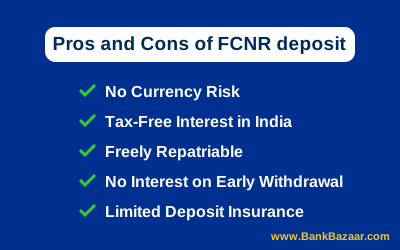
- Protection Against Exchange Rate Fluctuations: Since FCNR accounts are maintained in designated foreign currencies, both the principal and interest are protected from exchange rate fluctuations between the Indian Rupee and the deposit currency.
- Tax Benefits: Interest earned on FCNR deposits is exempt from income tax in India, subject to applicable regulations.
- Joint Account Facility: FCNR accounts can be opened jointly with one or more NRIs. However, joint accounts with resident Indians are not permitted.
- Multiple Currency Options: FCNR deposits can be maintained in several major foreign currencies, including the US Dollar (USD), Pound Sterling (GBP), Euro (EUR), Japanese Yen (JPY), and other permitted currencies.
- Full Repatriability: Both the principal amount and the interest earned are fully repatriable, allowing NRIs to transfer funds abroad without restrictions, subject to regulatory guidelines.
- Deposit Tenure: FCNR deposits are available for tenures ranging from 1 year to 5 years, depending on the bank's offerings and RBI guidelines.
- Interest Rates: Banks determine FCNR deposit interest rates within the limits prescribed by the Reserve Bank of India (RBI). The applicable rate varies based on the currency and deposit tenure.
- Interest Payout: Interest is generally compounded and paid as per the terms of the deposit, which may vary across banks.
- Loan Facility: Account holders can avail themselves of rupee loans against their FCNR deposits for permitted purposes in India. In certain cases, banks may also extend loans to firms or companies against FCNR deposits, subject to their lending policies.
Impact of FCNR Deposits on India’s Current Account Deficit
- Higher Interest Rates: To encourage foreign exchange inflows, the Reserve Bank of India (RBI) may periodically allow banks to offer higher interest rates on FCNR deposits.
- Boost to Foreign Exchange Reserves: Increased remittances from NRIs through FCNR deposits help strengthen India's foreign exchange reserves, which can contribute to reducing the country's current account deficit (CAD).
- Support for the Indian Rupee: A lower current account deficit can help reduce pressure on the Indian Rupee and support its stability against other currencies.
- Impact of Global Economic Conditions: Changes in global monetary policies, such as adjustments to interest rates by the US Federal Reserve, can influence foreign investment flows into India and affect the attractiveness of FCNR deposits.
Attracting NRI deposits through FCNR deposits
While raising interest rates under the FCNR deposit scheme may prove beneficial for NRIs, RBI have certain protective measures for banks in India such as facility of swapping the US dollar funds at a fixed rate (usually 3.50%). The swap facility and the high interest rates offered on FCNR deposits can cease with prior notice since they reportedly expose the RBI to incur losses running to thousands of crores. The RBI, therefore, may discontinue the said facility and reduce interest rates if it attracts the desired forex reserves into the country.
Some of the disadvantages of the Foreign Currency Non Resident (FCNR) Fixed Deposit Account are as follows:
- Bank Credit Risk: Although FCNR deposits are considered relatively safe, repayment depends on the financial stability of the bank. Deposit insurance in India is provided by DICGC up to the prescribed limit per depositor per bank, subject to the applicable terms and conditions.
- Restrictions During Financial Crises: In exceptional economic or banking crises, temporary restrictions on fund withdrawals or repatriation may be imposed by regulatory authorities.
- Premature Withdrawal: If an FCNR deposit is withdrawn before completing the minimum prescribed tenure, interest may not be payable, depending on the bank's policy.
- Loan Eligibility: Loans against FCNR deposits are generally available only to the account holder, subject to the bank's lending norms.
- Term Deposit Only: FCNR accounts are available only as term deposits and cannot be opened as savings, current, or recurring deposit accounts.
- Premature Closure and Transfer: FCNR deposits may be converted to eligible NRE accounts before maturity. However, premature closure may attract penalties and other charges as per the bank's policy.
- Renewal Rules: FCNR deposits should be renewed within the stipulated period after maturity. If not renewed on time, the applicable interest rate and renewal terms will be governed by the bank's prevailing policies.
- Taxation: While interest earned on FCNR deposits is generally exempt from tax in India for eligible NRIs, it may be taxable in the depositor's country of residence. It is advisable to consult a tax professional to understand the applicable tax implications.
- Regulatory Changes: The rules governing FCNR deposits, including investment and taxation, are subject to changes by the Reserve Bank of India (RBI) and the Government of India.
FAQs on Pros and Cons of FCNR Deposit
1.What are the currencies that you can opt for to open a FCNR deposit account?
FCNR deposit accounts can be opened in a number of different currencies which include the likes of USD, Pound Sterling, Euro, and so on.
2.Is FCNR deposit a good investment option?
Yes, FCNR deposits can be considered to be a good investment option for NRIs who are looking to invest in a term deposit scheme.
3.Is it possible to repatriate FCNR deposits?
Yes, it is possible. For FCNR deposits, you can easily repatriate the principal and the interest earned to the country of origin or the country of residence.
4.Are FCNR deposit accounts safe?
FCNR deposit accounts are one of the most secure investment options available for NRIs who are looking for an investment option.
5.How is FCNR deposit different from NRE deposit?
One of the key advantages of an FCNR deposit is that both the principal and interest are fully repatriable, while also protecting your funds from exchange rate fluctuations. In comparison, an NRE account may be more suitable for NRIs who intend to keep their savings and investments in India for future use.

Disclaimer
Credit Card:
Credit Score:
Personal Loan:
Home Loan:
Fixed Deposit:


Copyright © 2026 BankBazaar.com.