


Short-Term Vs Long-Term Fixed Deposits
Searching for choices that offer proper financial security and the advantage of a guaranteed return, either in the short-term or long-term, becomes important when thinking about financial planning. Among investors, fixed deposits are thought to be the preferred choice.

In addition to being simple to understand, FDs are among the most low-risk options to build savings. However, it is important to understand the basic differences between short-term and long-term FD before choosing this choice.
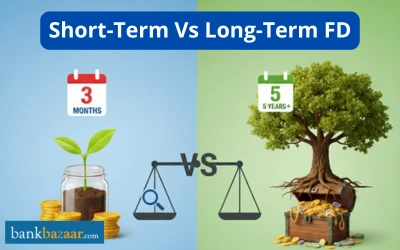
What is a Short-Term Fixed Deposit?
A short-term fixed deposit is a type of financial instrument that banks and other financial institutions provide that enables people to deposit a certain amount of money at a predefined interest rate for a specified amount of period. Short-term describes the deposit's comparatively short duration, which usually ranges from a few weeks to a few months.
Benefits of Short-Term Fixed Deposit
Here are some of the benefits of short-term fixed deposits as follows:
- Short-term fixed deposit investments are locked in for a predetermined amount of time to earn interest, much like other fixed deposit plans
- Short-term FDs have a duration of 7 days to 2 years. Banks differ in the minimum deposit amounts they require
- Investments are not impacted by market forces, making it one of the safest investing options
- Interest rates for 3 months or one-year fixed deposits remain stable and typically double those of savings accounts
- Small financial savings and short-term financial objectives, such as buying a gift for a family member, are best served by short-term FDs
- These FD schemes do not offer liquidity because they are short-term. Therefore, it is recommended to hold off on withdrawing this amount until the end of the term.
What is a Long-Term Fixed Deposit?
A long-term fixed deposit is a type of financial instrument that banks and other financial institutions offer that enables people to deposit a certain amount of money at a fixed interest rate for a long time. Long-term fixed deposits have a longer tenure than short-term ones, typically lasting a few to several years.
Benefits of Long-Term Fixed Deposit
Here are some of the benefits of long-term fixed deposits as follows:
- Opening a long-term FD account is very easy. The entire application procedure is simple, clear, and easy to understand
- Investors can choose from a variety of long-term FDs with varying maturity terms, depending on their individual suitability
- Additionally, long-term FD offers the option of auto-renewal, in which case the FD account is automatically renewed without requiring any additional steps
- FD plans, such as five-year fixed deposits, provide investors with good liquidity and can serve as a safety net in case of an emergency
- Long-term financial objectives, such as a down payment on a house or the purchase of a new vehicle, can be achieved with fixed deposits that last five to ten years
- Long-term FDs ensure a return on maturity and offer an attractive high interest rate of 6%–7%
- Additionally, investors have the option to take an early withdrawal from the account. They must, however, notify the bank or financial institution of these things.
Short-Term vs Long-Term Fixed Deposits
Here is the difference between short-term and long-term fixed deposits as follows:
Short-Term Fixed Deposit | Long-Term Fixed Deposit |
The tenure of short-term fixed deposits is usually only a few weeks to a few months. | The period of long-term fixed deposits is usually many years. |
They are appropriate for people who wish to invest their money for only a short period and get access to the funds soon because they have a shorter commitment term. | They are suitable for people who can commit to holding onto their investments for a longer amount of time without requiring instant access to the money. |
When compared to longer-term options, short-term fixed deposits frequently provide lower interest rates. | People can maximize their profits over time with long-term FDs because they frequently offer higher interest rates than short-term ones. |
FAQs on Short-Term Vs Long-Term Fixed Deposits
1.What is a Short-Term fixed deposit?
A Short-Term fixed deposit is a type of financial instrument that banks and other financial institutions provide that enables people to deposit a certain amount of money at a predefined interest rate for a specified amount of period.
2.What is Long-Term fixed deposit?
A Long-Term fixed deposit is a type of financial instrument that banks and other financial institutions offer that enables people to deposit a certain amount of money at a fixed interest rate for a long time.
3.What are the benefits of Long-Term fixed deposits?
Long-Term fixed deposits provide many benefits such as Long-term FDs ensure a return on maturity and offer an attractive high interest rate of 6%–7%, Investors can choose from a variety of long-term FDs with varying maturity terms, depending on their individual suitability.
4.What are the benefits of Short-Term fixed deposits?
Short-Term fixed deposits provide many benefits such as Small financial savings and short-term financial objectives, such as buying a gift for a family member, are best served by short-term FDs, Interest rates for 3 months or one-year fixed deposits remain stable and typically double those of savings accounts.
5.What are the disadvantages of a fixed deposit term?
A penalty charge may result from an early withdrawal of FD. As a result, while withdrawing the money, the investor might receive less interest in the total amount invested.

Disclaimer
Credit Card:
Credit Score:
Personal Loan:
Home Loan:
Fixed Deposit:


Copyright © 2026 BankBazaar.com.