


Car Loan Approval with Bad or Low Credit Score
Yes, you can secure a car loan with a low CIBIL score by improving your credit profile, providing a larger down payment, or enlisting a guarantor with strong creditworthiness. Interest rates will be higher than standard loans. Multiple lending options remain available through banks and NBFCs.
Owning a car is not only a status symbol but also a necessity these days. Whether you are driving to work in rush hour traffic or picking up your children from school, having a car is convenient.
There are innumerous makes and models of cars available on the Indian market to meet the varying needs of the consumers. From sports utility vehicles (SUV) and multi-utility vehicles to passenger cars and commercial vehicles, you can own a car of your dreams with easy funding from banks, Non-Banking Financial Companies (NBFC) and other lending institutions.
Although there are many avenues to obtain financing for the purchase of your dream car, due to certain factors, a car loan application can get rejected. One of the reasons is having a bad credit score. It can reduce one's chances of loan approval by the banks. Before applying for a car loan, shop around, do your research online to get a better deal.
Whether it is new car loan or used car loan, visit a comparison website to compare various car loan offers across top banks in the country. Choose a low-interest rate car loan to save up on interest payments. Some banks also offer loan against car.
Car Loan Eligibility with Bad or Low Credit Score
Before applying for a car loan, it is important to check one's eligibility of the loan in terms of income and credit score. Here is the standard eligibility criteria set by banks for car loan applicants:

- The applicant must be minimum 21 years to maximum 65 years of age.
- He or she must have a minimum annual income of Rs.2 lakh for any approved make or model of car.
- In the case of self-employed applicants, he or she must have minimum 1 year experience in the same field.
- Salaried individuals must have minimum 2 years of work experience.
Some banks offer pre-approved car loans for existing customers with just minimal documentation like KYC papers.
1. Minimum CIBIL Score: A score of 750+ qualifies for best rates; 650–749 attracts standard rates; 600–649 incurs higher rates; below 600 requires NBFC consideration with income verification.
2. Loan-to-Value (LTV) Ratio: Lenders assess the car's market value; a lower LTV (typically 70–80%) improves approval odds and reduces interest costs.
3. Pre-Approval Benefits: Existing bank customers may receive pre-approved car loans with minimal documentation, faster processing, and preferential rates despite bad credit.
Documents Needed for Car Loan with Poor Credit
Along with a duly-filled and signed application form, it is important to submit valid documents such as:
- Age proof: Birth certificate, PAN Card, Passport, Voter's ID or Driving Licence can be submitted as age proof.
- Identity proof: Voter's ID, Aadhaar Card, PAN Card, Passport or Driving Licence can be submitted as identity proof with a number of latest passport-size photograph.
- Address proof: Ration card or utility bills such as electricity bill, telephone bill and water bill can be submitted as valid address proof.
- Income proof: The latest salary slip, last month's bank statement, ITR, Form 16, etc can be submitted as income proof for salaried and self-employed individuals accordingly.
- Bank Statements: Submit 2–3 months of latest bank statements to demonstrate financial stability and regular income deposits.
- Co-Signer Documentation: If using a guarantor, provide their PAN, Aadhaar, income proof, and credit report to strengthen your application.
Prior to submitting the application form, ensure the particulars furnished by you are valid so as to avoid loan rejection on the basis of misrepresented, false or incomplete data.
How to Apply for a Car Loan with Low Credit Score
One can apply for car loan either through the online method or the offline method:
- Online method involves the submission of an online car loan application through the bank website or a third-party website. Fill up the online application form and submit it along with the necessary documents such as valid identity proof, address proof, age proof, and income proof.
- Offline method involves visiting a bank branch in person and applying for a car loan with the help of a bank executive. The executive will verify the documents provided before approving or rejecting the loan. When it comes to loan approval, price of the car, make and model of the car, and the applicant's income and credit score are the key deciding factors.
- Approval Timeline: Online applications for existing customers process in 24–48 hours; first-time applicants require 5–7 days for credit assessment and fund disbursement within 2–3 working days.
Minimal documentation or paperwork is involved in the online method in comparison to the offline method. Also, banks provide special offers to customers who apply for a car loan online so as to facilitate a digital economy.
Why Credit Score Matters When Applying for a Car Loan
- In the case of car loan, the car serves as collateral. Therefore, even with a bad credit score, there are chances of a bank or NBFC approving your car loan application.
- Credit Information Bureau India Limited (CIBIL) is a reputable credit bureau of the country that gathers credit-related data about individuals and companies from banking and financial institutions.
- Credit score is determined based on the individual's credit utilisation, payment history, type of credit, etc.
- This data is used to analyse and evaluate a person's credit score and credit history.
- When applying for a loan, a person's credit score is taken into account as it represents the person's creditworthiness i.e., it indicates the repaying capacity of an individual.
Steps to Improve Credit Score Before a Car Loan
Banks approve loan applications of those individuals with a good credit score. A credit score of 750 or above is considered a good credit score while 650 and below are considered bad credit scores. There are ways in which one can improve his or her credit score such as:
- Making loan EMI payments and credit card bill payments on or before the due date. Any skipped, delayed or partial payment can negatively affect the credit score.
- Maintain a balance between secured and unsecured loans like car loans and personal loans, respectively. Secured loans are those loans that are obtained by pledging a collateral or security like car loan and home loan whereas personal loans are unsecured loan which doesn't require collateral. Unsecured loans are disbursed purely based on one's creditworthiness.
- Don't foreclose your loan prematurely. When you come into unexpected inflow of cash, then you can make partial prepayments of your loan but don't close the loan before its term.
- Don't apply for multiple loans at the same time. Too many rejection can definitely affect your credit score negatively. Every time you apply for a loan, a hard enquiry is made, and each hard enquiry affects your credit score.
- Check your loan eligibility before applying for a car loan. Nowadays, credit report of an individual can be obtained easily through online platforms. Go through your credit report to find out your credit score. If there are any errors in your credit report, immediately intimate the credit bureau to have it rectified. You can get a free credit report once a year from any of the credit bureaus of India, namely Experian, EQUIFAX or CIBIL.
- Don't exceed your credit limit, keep your spending to 30% of the credit limit. Prioritise between needs and wants so as to avoid unnecessary expenses.
- Timeline for Score Recovery: Expect 3–6 months for visible improvement with consistent payments; 12–24 months to recover from poor credit (300–500) to acceptable (650+); negative information persists for 3–7 years.
If an applicant has a history of numerous debts, late payments or bankruptcy, it indicates that the person is at a high risk of defaulting on loan payments. That is why, banks prefer to disburse loans to those with a good credit history and credit score.
Tips to Get a Car Loan with Bad or Low Credit Score
A significant number of the Indian population either has low credit score or no credit history. Even so, with the advent of technology in the finance segment, lenders have introduced new methods by which to provide funding to individuals with bad credit.
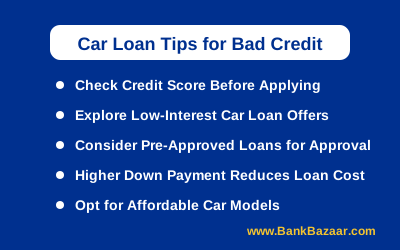
- Check your car loan eligibility: Getting car loan with bad or low credit score can prove costlier compared to those with a good credit score. Obtain a free credit report from one of the credit bureaus of India. If you have a bad credit score, work on improving it before applying for the loan. Some ways by which you can improve your credit score is by paying off existing debts, outstanding dues, and making payments on time.
- Don't apply for multiple loans in a short time: Prior to applying for a car loan, clean up your credit and don't take up additional credit obligations. When processing your loan application, banks will look for red flags such as late payments, outstanding debts, tax liens, bankruptcy, etc.
- Check the current interest rate of car loan: Compare various car loan offers online and choose a car loan with a low interest rate. Applicant with a good credit score can get better rates than one without. Interest rate of car loan determines the overall cost of your loan and EMI payments.
- Volunteer to make a higher down payment: When you make a sizable down payment on your car, the total cost of the car loan comes down. A higher down payment also means lower interest payments and processing fees. Processing fee of a car loan is a small percentage of the principal loan amount to be processed by the bank. It has to be paid upfront by the borrower at the time of receiving the loan.
- Borrow according to your repayment capacity: EMI payments shouldn't exceed 50% of your salary. Maintain a low debt-to-income ratio. A high debt-to-income ratio means higher chances of defaulting on loan payments. You can calculate your monthly EMI payments for the chosen loan amount using the car loan EMI calculator which is available on the bank website and third-party websites. Just enter the loan amount, loan tenure, interest rate, and processing fee into the tool and click on 'Calculate'. The tool will present you with instant and accurate results in the form of an amortisation table. The table consists of your payment schedule like monthly EMI payments, overall interest payment, outstanding balance after each EMI payment, etc.
- Apply for pre-approved loan from your bank: Some banks offer pre-approved loans to existing customers based on just their KYC paperwork. In such a case, even with a bad credit score, you have higher chances of obtaining a car loan from your bank. Talk to the relationship manager at your bank and negotiate terms.
- Opt for a model of car that fits your budget: Applicants with a bad credit score may not get a huge car loan. Therefore, go for a model of car that doesn't exceed your budget and if necessary, make do without certain lavish features like advanced speaker system or sun roof.
- Lease a car instead of purchasing one: Lease payments are comparatively lower. This is an option only if you don't cover too many miles in the car. Or else, you will end up paying high service charges and other fees. Also, this is an ideal option for those who have a penchant for changing cars every few years.
- Choose carefully when obtaining funding from NBFCs or other lending institutions: Car dealerships will recommend few financing options but you have to be careful when weeding them out. Go for reputable lenders with credibility. If the offer is too good to be true, it most likely is.
- Read the documents carefully: Go through all the paperwork involved in your car loan application and processing with a fine-toothed comb. If you are unaware of certain jargons or have queries about the car loan terms and conditions, don't hesitate to verify with the bank executive. Get acquainted with the prepayment or foreclosure charges levied by the bank. A percentage of the outstanding balance is charged for prepaying the loan before the end of the loan tenure.
- Opt for second-hand cars: Most banks offer used car loans for the purchase of certified pre-owned cars. However, used car loans come with higher interest rates than new car loans.
- Loan against car: Loan against FD and Loan against Car are other alternatives to new or used car loan Your FD or existing car can be used as collateral to obtain funding to purchase a newer model of car.
- NBFC Advantages: Non-Banking Financial Companies approve loans for credit scores below 600, require less documentation, process faster (3–5 days), but charge 1–3% higher interest rates to offset risk.


FAQs on Car Loan Approval with Bad or Low Credit Score
1.What is a bad credit car loan?
A bad credit car loan is a financing product designed for borrowers with CIBIL scores below 650, offering approval at higher interest rates to compensate for perceived repayment risk.
2.What credit score do I need for a car loan?
Most banks require 650–750+ for standard rates; scores of 600–649 incur higher rates; NBFCs approve scores as low as 300–600 based on income and repayment capacity.
3.Can I get a car loan with a score below 600?
Yes, specialised NBFCs approve loans for scores below 600 if you demonstrate stable income and strong repayment ability; however, interest rates will be considerably higher than bank loans.
4.What factors affect loan approval besides credit score?
Lenders evaluate income stability, employment history, debt-to-income ratio, down payment size, co-signer creditworthiness, vehicle value, and your payment history.
5.How much down payment improves approval chances?
A down payment of 30–50% of the vehicle price significantly improves approval likelihood, reduces lender risk, and lowers your overall interest burden.
6.What is a co-signer and how do they help?
A co-signer (credit score 700+) guarantees your loan obligation; their strong creditworthiness improves your approval odds and can secure 1–2% better interest rates.
7.Can self-employed people get car loans with bad credit?
Yes, self-employed applicants can qualify by providing 2–3 years of audited financials, ITR returns, and bank statements demonstrating consistent income growth.
8.What documents must I provide for a bad credit car loan?
Required documents include PAN, Aadhaar, address proof, 2–3 salary slips or ITR, latest 2–3 months bank statements, employment letter, and co-signer documents if applicable.
9.How long does approval take for bad credit applicants?
Online applications for existing customers process in 24–48 hours; first-time applicants require 5–7 days for document verification; fund disbursement follows within 2–3 working days.
10.What is loan-to-value (LTV) ratio and why it matters?
LTV compares your loan amount to the vehicle's market value; lower LTV (70%) indicates lower lender risk, improving your approval odds and reducing interest costs.
11.Which vehicles are easier to finance with bad credit?
Used or certified pre-owned vehicles, mid-range sedans, and hatchbacks; dealers typically have approved car lists and flexible financing partnerships for bad credit applicants.
12.What are EMI, processing fees, and prepayment charges?
EMI (Equated Monthly Instalment) includes principal and interest; processing fees (1–3%) deduct upfront; prepayment penalties charge a percentage of outstanding balance if you foreclose early.
13.Can I refinance my car loan later to get better rates?
Yes, after 12–24 months of consistent on-time payments, refinancing through balance transfer options can secure 1–2% lower rates as your credit improves.
14.What happens if I miss an EMI payment?
Late fees apply immediately, penalty interest accrues, your credit score suffers damage, and multiple defaults (2–3) risk vehicle repossession by the lender.
15.Should I pledge my car as collateral for other loans?
No; pledging your car for other loans risks repossession if you default; instead, explore unsecured personal loans or credit card options with higher interest rates.
16.How does credit score impact car loan interest rates?
Every 100-point difference can mean 0.5–2% rate variation; a 550 score vs. 700 score can cost Rs.1–3 lakh extra over the loan tenure.
17.What is the difference between secured and unsecured car loans?
Secured loans use the car as collateral (lower rates, easier approval); unsecured loans require excellent creditworthiness (750+) but no collateral pledge.
18.Can I extend loan tenure to reduce monthly EMI?
Yes, extending tenure lowers monthly EMI but increases total interest paid significantly; balance affordability against the total loan cost before deciding.
19.How is debt-to-income (DTI) ratio calculated and why matters?
DTI = total monthly debt payments ÷ gross income;
lenders prefer DTI below 40–50%, ensuring you can manage the car loan alongside existing financial obligations.
20.How do I monitor my credit score after loan approval?
Check your CIBIL score free annually at official bureaus; use credit monitoring apps monthly; ensure all EMI payments are reported correctly to track score improvement.
Car Loan Articles
- Car Prices in India
- How To Transfer a Car Loan to Another Person
- How GST Affected Car Prices in India
- Car Lease Vs Car Loan
- Car Loan Foreclosure Procedure
- Vehicle Registration
- Car Loan Document Checklist
- Bad Credit Car Loan
- Car Loan Refinancing
- Zero Downpayment Car Loan
- Commercial Car Loan
- Car Loan for Nris
- Car Loan Schemes for Women
- Car Loan Preclosure
- Transfer Car Registration
- Top 10 Banks for Car Loan
- Car Loan Schemes for Government Employees
- Fuel Efficient Sedan Cars
- Automatic Cars for Women
- Chepest Cars in India

Disclaimer
Credit Card:
Credit Score:
Personal Loan:
Home Loan:
Fixed Deposit:


Copyright © 2026 BankBazaar.com.