


Section 44AD of Income Tax Act
Section 44AD provides tax relief to certain individuals and professionals so they don't need to get an audit performed or show books. This is not applicable for assessees with professions listed under Section 44AA.
What is Section 44AD of Income Tax Act?
The presumptive taxation scheme allows taxpayers with business or professional income to declare profits as a fixed percentage of turnover, simplifying tax compliance without maintaining detailed books (subject to limits).
Under Section 44AD, businesses with turnover up to Rs.2 crore can declare income at 8% of turnover. This extends to Rs.3 crore with a reduced rate of 6% if cash receipts do not exceed 5% of total receipts. For professionals, Section 44ADA permits those with gross receipts up to Rs.75 lakh to declare 50% of receipts as taxable income.
However, with the recent updates in the Budget 2020, the scope of Section 44AD and its benefits have also been extended to include professionals whose total income over the duration of the financial year is below Rs 50 lakhs.
Features Of Section 44AD
The key features of Section 44AD are mentioned below:
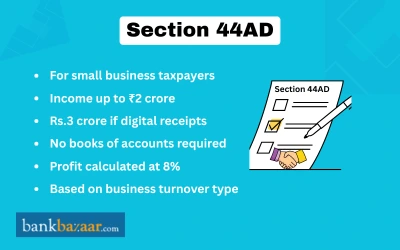
- Presumptive Tax Rate under Section 44AD: Tax is calculated at 8% of gross turnover (or 6% for digital transactions), applicable only if turnover does not exceed Rs.2 crore in a financial year.
- Applicability of Section 44AD: This section applies to most businesses, except those covered under Section 44AE of the Income Tax Act.
- Taxation as per Slab Rates: Income declared under Section 44AD is taxed according to the applicable income tax slab rates.
- Restriction on Deductions: Taxpayers opting for this scheme cannot claim additional expenses or depreciation.
- Exception for Partner Payments: Under this section, interest or remuneration paid to partners can still be claimed as a deduction.
Eligibility Criteria to Claim Deductions Under Section 44AD
Section 44AD is applied to businesses, professionals, and partnership firms. The presumptive taxation scheme can be availed by:
- Resident individuals
- Resident partnership firms excluding LLPs (Limited Liability Partnership)
- Resident Hindu Undivided Families (HUFs)
Note: Eligibility is subject to the condition that annual turnover or gross receipts do not exceed the prescribed limit in the previous financial year.
The business types not eligible for Section 44AD are listed below:
- Individuals claiming deductions under Sections 10A, 10AA, 10BA, 10B, or similar income-related exemptions.
- Companies engaged in hiring or leasing goods carriages, agency businesses, or transport services covered under Section 44AE.
- Individuals or firms earning income through commission or brokerage.
Application Of Section 44AD
Section 44AD is applicable except for some conditions, such as:
- Gross Receipts Limit: The total professional income must not exceed Rs.50 lakh in a financial year to be eligible under Section 44ADA.
- Minimum Presumptive Income Requirement: The taxpayer must maintain proper books of accounts, if declared income is less than 50% of gross receipts.
- Basic Exemption Threshold Condition: If total income exceeds the basic exemption limit, maintaining books of accounts becomes mandatory.
Application Of Section 44AD With Regards to Allowances and Disallowances
It is important to evaluate the key features of Section 44AD before opting for the presumptive taxation scheme. The allowances and disallowances under section 44AD are mentioned below:
- Disallowance of Deductions: Taxpayers choosing Section 44AD cannot claim deductions under Sections 30 to 38, including depreciation.
- No Additional Disallowances: Once opted, disallowance provisions under Sections 40, 40A, and 43B are not applicable.
- Allowance for Partnership Firms: Partnership firms opting for Section 44AD can claim deductions for partner remuneration and interest under Section 40(b).
- Limits on Partner Deductions: Deductions for partner payments are subject to prescribed limits under Section 40(b).
Application Of Section 44AD With Regards to Lower and Higher Income Declaration
The details on application fo Section 44D with respect to lower and higher income declaration are mentioned below:
- Declaring Lower Income under Section 44AD: If total turnover does not exceed Rs.2 crore, taxpayers can declare income lower than 8% of turnover (or 6% for digital transactions).
- Declaration of Higher Income: If actual business income exceeds the presumptive limits, taxpayers must declare the higher income, even if it is above 8% (or 6% for digital transactions).
If income is declared below the prescribed rate and turnover exceeds Rs.2 crore, taxpayers must:
- Maintain books of accounts as per Section 44AA
- Get accounts audited as per Section 44AB
Other Details About Section 44AD
Below mentioned are some other vital details about Section 44AD:
Advance Tax under Section 44AD
- Advance tax is the tax paid in advance based on estimated annual income.
- Advance tax payment on business income covered under this section is not required for taxpayers opting for Section 44AD.
- However, if income includes commission exceeding Rs.10,000, advance tax provisions will apply.
Depreciation and Written Down Value (WDV)
- Taxpayers under Section 44AD cannot claim depreciation separately.
- However, for assets used in such businesses, the WDV is calculated as if depreciation has been allowed under Section 32.
Section 44ADA for Professionals
- Applicable to professionals such as lawyers, doctors, architects, engineers, interior decorators, technical consultants, and chartered accountants.
- Eligible if total professional income does not exceed Rs.50 lakh in a financial year.
- Taxable income is presumed to be 50% of total gross receipts when opting for this scheme.
Conditions for Section 44AD
Taxpayers opting for the presumptive taxation scheme under Section 44AD must continue for at least 5 consecutive years.
Condition for Availing the Scheme
- Profits must be declared as per the presumptive scheme for a continuous period of five years.
- If a taxpayer opts out before completing five years and switches to regular taxation (ITR-3), they will lose eligibility.
- Restriction on Re-Entry: The taxpayer cannot opt back into the presumptive scheme for the next five assessment years, if the scheme is discontinued before five years. For example, if a taxpayer opts for the scheme in AY 2026–27 but exits in AY 2027–28, they will be ineligible to re-enter the scheme for the following 5 years.
- Purpose of the Rule: This condition is introduced to prevent misuse of the scheme by frequently switching between taxation methods.
- Revised Turnover Limit: The turnover limit is extended to Rs.3 crore, provided cash receipts do not exceed 5% of total turnover.
Restriction on Re-Opting for Presumptive Scheme
The 5-year restriction under Section 44AD(4) applies only when a taxpayer declares income lower than 8% (or 6% for digital transactions).
When Does Restriction Not Apply?
The restriction is not applicable if the taxpayer is unable to opt for the scheme due to valid reasons, such as:
- Turnover exceeding the prescribed limit (Rs.2 crore or Rs.3 crore, as applicable).
- Business not qualifying under the presumptive scheme.
Illustrative Example
- In FY 2025–26, Mr. M opts for Section 44AD with Rs.1.7 crore turnover and Rs.11 lakh income.
- In FY 2026–27, his turnover increases to Rs.3.2 crore (making him ineligible for the scheme).
- In FY 2027–28, his turnover drops to Rs.1.8 crore.
- Since the taxpayer was ineligible (not voluntarily opting out) in FY 2026–27, the 5-year restriction does not apply. Therefore, he can opt for the presumptive scheme again in FY 2027–28 or FY 2028–29.
Note: When a taxpayer voluntarily declares lower income than prescribed under the scheme; the restriction is triggered, not when they are forced out due to ineligibility.
Requirement to Maintain Books of Accounts
If a taxpayer fails to comply with Section 44AD(4) (i.e., does not continue the presumptive scheme for 5 years) and their total income exceeds the basic exemption limit, they must maintain proper books of accounts.
Illustrative Example (Mr. R)
- FY 2024–25: Turnover Rs.2.6 crore; opts for presumptive scheme and declares profit above 8%.
- FY 2025–26: Turnover Rs.2.8 crore; declares profit below 8% and switches to regular taxation.
- Taxable income becomes Rs.8 lakh (above exemption limit).
Impact of Non-ComplianceBy declaring income below the presumptive rate, Mr. R becomes ineligible for the presumptive scheme for the next 5 years.
Books of Accounts and Tax Audit Requirement
During these 5 restricted years, if taxable income exceeds the exemption limit, the taxpayer must:
- Maintain books of accounts
- Get accounts audited
Tax Audit Applicability
Tax audit is required in the following cases:
- When turnover exceeds Rs.1 crore under normal taxation (irrespective of profit percentage)
- When Section 44AD(4) applies and total income exceeds the basic exemption limit
Basic Exemption Limits
- Individuals: Rs.2.5 lakh (old regime) or Rs.4 lakh (new regime).
- Firms and companies: No basic exemption limit.
What forms of remuneration or income do not form a part of the total turnover of an assessee with regards to computation of income under Section 44AD?
The following types of income will not be considered as part of the total turnover of an assessee when computing income under Section 44AD:
- The receipt of any advance payments or deposits
- Any commission earned through the sale of any fixed assets
- Any form of cash
- Any discounts or rebates
FAQs on Section 44AD
1.What is Section 44AD?
Section 44AD is a presumptive taxation scheme under the Income Tax Act designed for small businesses. It allows eligible taxpayers to declare income as a fixed percentage of their turnover. This also helps simplify tax compliance by removing the need to maintain detailed books of accounts or undergo audits.
2.What is presumptive income under section 44AD?
Presumptive income under Section 44AD is the income calculated as a fixed percentage of an eligible business’s total turnover or gross receipts. This amount is treated as taxable income, and taxpayers are not required to maintain detailed books of accounts.
3.What is turnover under section 44AD?
Under Section 44AD, turnover refers to the total sales generated by a business during a financial year. It includes the combined value of all cash and credit sales, but excludes any taxes levied on those sales.
4.How to calculate tax under section 44AD?
Under Section 44AD, tax is computed on presumptive income, and it is calculated as a fixed percentage of total turnover or gross receipts (currently 8% for businesses). As this presumptive income is considered the taxable income, taxpayers are not required to maintain detailed books of accounts.
5.What if the assessee in question is conducting or running multiple businesses?
If a taxpayer operates multiple qualifying businesses, they can opt for the presumptive taxation scheme for each one individually. In such cases, both turnover and presumptive income must be computed independently for every business.
6.What if the assessee in question is conducting both a business and a profession?
If a taxpayer earns income from both an eligible business and a profession, then the presumptive taxation scheme under Section 44AD must be opted for the business income. However, professional income must be calculated separately as per the regular provisions of the Income Tax Act.
7.What is the income tax form required to be filed by an assessee under Section 44AD?
If an assessee chooses to file his or her tax returns under Section 44AD, then an ITR Form 4S-Sugam will be required to be used to file said returns.

Disclaimer
Credit Card:
Credit Score:
Personal Loan:
Home Loan:
Fixed Deposit:


Copyright © 2026 BankBazaar.com.