


Income Tax Return (ITR)
What is ITR?
Income Tax Return (ITR) is a form used to report your income and the applicable taxes to the Income Tax Department for a specific fiscal year.
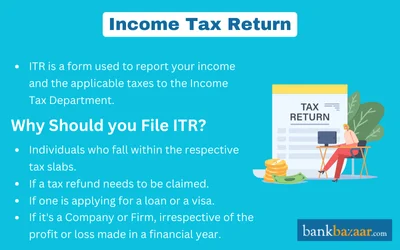
Every Indian taxpayer must file a formal declaration known as the Income Tax Return (ITR) with the tax authorities to report their annual income, expenses, and tax liability for a specific financial year.
This declaration serves as a record that allows the government to assess whether the individual or entity has paid the correct amount of tax based on their total earnings from various sources, such as salary, business profits, house property, or capital gains.
A filed ITR is also a document for financial credibility, often required for securing loans, processing visa applications, and claiming tax refunds. By submitting an ITR, taxpayers fulfill their legal obligation while ensuring transparency in their financial dealings with the state.
Why Should You File ITR?
It is mandatory for one to file income tax returns in India, if he comes under any of the following conditions:
- When a tax refund is to be claimed.
- Individuals whose income falls within the applicable tax slabs.
- Companies and firms, regardless of whether they have made a profit or incurred a loss during the financial year.
- If a loss under any head of income needs to be carried forward
- When applying for a loan or visa
- If a resident Indian holds any asset or financial interest outside India or is a signing authority in a foreign account.
- If an NRI earns income from sources in India.
If income is received from the property held under a trust for charitable or religious purposes, or by entities, such as:
- Political parties
- Research associations
- News agencies
- Educational or medical institutions
- Trade unions
- Not-for-profit universities
- Hospitals
- Infrastructure debt funds, or
- Other specified authorities or trusts
Importance of Filing Income Tax Return (ITR)
Filing your income tax returns in the specified format offers the following benefits:
- Your Capital Losses and Gains will get an Adjustment
If equity or share market investment has been your topmost investing agenda, then timely filing of income tax return will prove to be extremely rewarding for you.
- Easy to Claim Tax Refunds
Once deduction of a certain kind of tax takes place, one can only claim a tax refund if one is filing an income tax return, for that particular fiscal year.
- Easy to Apply for Loans
Apart from being just another important financial document, your income tax return also acts as proof for your income as it indicates all the earnings that you have made in a single year.
- Easy to Claim Tax Deductions
If you are earning more than Rs.3 lakh, and are also seeking for multiple exemptions in order to bring your income down to that level, you will undoubtedly be required to file your ITR for that particular fiscal year.
- Ease of Owning Assets (foreign assets): If you maintain an Income Tax Return record, it provides the necessary legal documentation and financial transparency required to facilitate the acquisition, disclosure, and ownership of assets located in foreign jurisdictions.
How to File ITR?
Every individual can file their Income Tax Returns (ITR) either through online or offline methods as comfortable for them:

Online Process
Visit the official e-filing portal of the income tax department which has recently updated the online portal for e-filing of income tax returns and can be filed.
- Visit the official Income Tax Portal.
- Log into the portal using your PAN as the user ID and your encrypted password.
- From the home page, navigate to the e-File option.
- Click on ‘Income Tax Returns’ and then to ‘File Income Tax Return’.
- Select the correct Assessment Year, such as, for FY 2025–26, choose AY 2026–27.
- Choose your filing status (Individual, HUF, or others). Salaried and freelance taxpayers should generally select Individual.
- Select the appropriate ITR form, as per your income and sources.
- Specify the reason for filing the ITR, such as income exceeding the exemption limit or meeting specified conditions.
- Enter the required details, such as personal details, bank account information, deductions, income details, and taxes paid.
- After successfully filing, complete the process by e-verifying your return.
Offline Process
To file your ITR offline, visit the official income tax e-filing portal and navigate to the IT Return Preparation Software section to download the appropriate ITR form. Then Open the downloaded form on your computer and fill in the required details.
Ensure you have essential documents like Form 16, Form 26AS, and TDS certificates ready for reference. After completing the form, generate a JSON file and save it. Finally, upload the JSON file on the portal to submit your ITR.
Documents Required to File ITR
Depending on the tax bracket the individual falls under, the list of documents that are needed will differ. Some of the common list of documents that are needed to file ITR are mentioned below:
- Pan card
- Form 26AS
- Form 16
- Salary Pay slips
- Bank statements
- Interest certificates
- TDS certificate
- Proof of tax saving investments
Types of ITR Forms
Depending on the type of income that is generated by the taxpayer, the form that must be submitted will be different. The different types of ITR forms that are available are mentioned below:
Form | Details |
ITR-1 or Sahaj | The ITR-1 or Sahaj form must be used by individuals who make an annual income of less than Rs.50 lakh via pension or salary and from only one house property. |
ITR-2 | The ITR-2 form must be used by shareholders of private companies, Directors of Companies, Non-Resident Indians (NRIs), or individuals who make an income via capital gains, from two or more house properties, and from foreign sources. However, the income of the individual must be more than Rs.50 lakh. |
ITR-3 | The ITR-3 form is specifically designed for individuals and Hindu Undivided Families (HUFs) who earn income from a proprietorship business or profession. |
ITR-4 or Sugam | Individuals who are under the presumptive taxation scheme must use ITR-4 form. In order for individuals to join the scheme, they must earn less than Rs.50 lakh from professional income or less than Rs.2 crore from business income. |
ITR-5 | In order for association and body of individuals, Limited Liability Partnerships (LLPs), and partnership firms to report their income and tax computation, ITR-5 Form must be used. |
ITR-6 | The ITR-6 form is specifically designed for companies registered under the Indian Companies Act. All such companies, except those claiming exemption under Section 11 (applicable to charitable or religious organizations), must use this form to file their income tax returns. |
ITR-7 | In case entities are claiming an exemption as universities or colleges, scientific research institutions, political parties, and religious or charitable trusts, ITR-7 form must be used. |
Note: Depending on the type of income that is generated by the taxpayer, the form that must be submitted will be different. Read out more about which ITR Form to File in 2026.
Changes in Income Tax Form in 2026
The government has introduced several changes in Income Tax rules in 2026. Some of the commonly used tax forms have changed in structuring and numbering. They are as follows:
- Form 16 has been renamed as Form 130
- Form 26AS is now referred to as Form 168
- Forms 15G and 15H have been combined into a single Form 121
- Tax audit forms (3CA, 3CB, and 3CD) have been consolidated into one Form 26
The government has introduced these updates to simplify tax filing procedure, standardise reporting formats, and also align documentation with the framework of the Income Tax Act, 2025.
Types of Forms for ITR E-filing
It is important to understand the key forms used in the e-filing process and the information they contain before filing your income tax return. The list of forms is mentioned below:
Form 130
An employer issues the salary TDS certificate to an employee. Provides details, such as:
- Gross salary
- Exemptions such as HRA and LTA
- Net taxable salary
- Other income or losses reported
- Tax-saving deductions
- TDS on salary
Form 168
Provides consolidated statements of taxes linked to a taxpayer’s PAN. It shows the following details:
- TDS on income such as salary, interest, and property transactions
- Details of advance tax
- Self-assessment tax paid
- Specified financial transactions
Form 121:
This form is a combination of Form 15G and 15H and is used by individuals to declare that their income is below the taxable limit. This is done so that no TDS is applied on certain incomes like interest earned on fixed deposits.
Penalty for Late Filing of ITR
In case the returns are not filed by the due date, huge penalties are levied on the taxpayer. Apart from penalties, there could be other inconveniences and consequences that the individual would face in case the returns are not filed.
Depending on when the returns are filed after the due date, individuals could face penalties between Rs.1,000 and Rs.10,000.
Given below is the penalties that are levied for a delay in ITR filing:
Due Date of ITR Filing | Penalty for Income <Rs.5 lakh | Penalty for Income >Rs.5 lakh |
Before 15th September | Nil | Nil |
From 1 September to 31 December | Rs.1,000 | Rs.5,000 |
From 1 January to 31 March | Rs.1,000 | Rs.10,000 |
Apart from penalties, in case taxpayers are eligible to receive a refund, there will be a delay in case the ITR is filed late. Taxpayers will also have to pay a 1% interest on the pending amount in case the returns are not filed on time.
Union Budget 2026-2027: Key Proposals
The Union Budget 2026–27 left income tax rates unchanged but introduced targeted measures to simplify tax compliance for individuals and small taxpayers, and those are listed below:
Income tax (I-T) filing due date extended:
- The due date for filing ITR-3 and ITR-4 has been extended to 31 August instead of 31 July.
- This extension of due date applies to non-audit business cases and trusts.
Updated returns:
- Taxpayers can file updated tax returns to disclose additional income even after the original return is filed.
- This facility is available for up to four years from the end of the relevant tax year.
- Updated returns can be filed with an additional tax of 25%, 50%, 60%, and 70% from the first to the fourth year, respectively, from the year of original filing.
- The Budget proposes allowing updated returns even after reassessment proceedings are initiated by the IT Department.
- In such cases, an additional 10% tax will apply over and above the applicable rate for the relevant year.
- No penalty will be levied on the additional income disclosed in an updated return.
Focus on Small Taxpayers
- To disclose income or assets below a certain size that one-time six-month foreign asset disclosure scheme introduced for small taxpayers, such as relocated NRIs, students, young professionals, and tech employees.
- Instead of filling out the application with the assessing officer, rule-based automated processes are enabled for obtaining a nil or lower deduction certificate.
Note: New Income Tax Act will be effective from 1 April 2026.
FAQs on Income Tax Return (ITR)
1.What is NIL ITR?
NIL-ITR can be filed when your total salary is less than the exemption limit, yet you want to go ahead and file an income tax return.
2.Can I File Income Tax Return after Due Date?
Yes, you can file your Income Tax Return after the due date. However, a penalty of Rs.1000 (for Income <5 Lakh) and Rs. 5000 (for Income >50 Lakhs) will be levied in case the ITR is filed after the due date.
3.What is Income Tax Return Notice?
Income Tax Return Notice is a Letter sent by IT Department to a taxpayer alerting him to an issue with his tax account and submitted documents.
4.Can I file the ITR myself?
Yes, you can file the ITR by visiting the official website of the Income Tax Department.
5.How to Check the Status of Income Tax Return?
The status of the Income Tax Return can be checked on the official website of the Income Tax Department of India. The status can be checked with the help of your Permanent Account Number and password.
6.Is it mandatory to file the ITR?
In case you fall under the tax bracket that is provided by the government, it is mandatory to file the ITR.
7.Are there any penalties levied in case the ITR is not filed?
Yes, penalties are levied in case the ITR is not filed.
8.Is it mandatory for salaried employees to file the ITR?
Salaried employees who fall under the tax bracket must file the ITR.
9.If I have already paid advance taxes and have no dues or refunds, can I skip filing of income tax return?
No, it is mandatory to file your ITR. The government get a complete record of how your income is distributed with the help of the ITR.
10.Is an ITR useful to me in daily life?
Yes, it is useful to file your tax returns. In case you wish to apply for a loan, the ITR may be considered as a mandatory document that must be submitted.
News About Income Tax Return
Assessment Year Renamed Tax Year
According to the Income Tax Act 2025, the terms “Financial Year” and “Assessment Year” will be simplified into “Tax Year”. From 1 April 2026, the 12 months commencing from 1 April to 31 March will be termed the “Tax Year”. This eliminates confusion regarding the two longstanding terminologies and simplifies the concept, especially for the new taxpayers.
Union Budget 2026: Income Tax Return Dates Revised
In the Union Budget 2026, the Finance Minister Ms. Nirmala Sitharaman announced new deadlines for Income Tax Returns. As per the new rule, the deadline for ITR revision has been extended from 31st December to 31st March, with a small nominal fee. She also said that the regular filing deadline for individual taxpayers using ITR‑1 and ITR‑2 will be the same as 31st July. The revised return deadline for non-audit individuals has been extended to 31st August. This is done with the aim of giving taxpayers more time to correct or update their filings.
Union Budget 2026: Proposal to allow more time to update returns and reduction in prepayment amount
In the Union Budget 2026, the Finance Minister Ms. Nirmala Sitharaman announced a proposal to allow taxpayers to update their returns even after the reassessment proceedings have started, with the assessing officer using only the updated returns in the subsequent proceedings.
Furthermore, there will be no interest liability on the taxpayer on the penalty amount for the appeal period before the first appellate authority irrespective of the appeal process outcome. The quantum of prepayment will also be reduced to 10% from 20% and will continue to be calculated only on core tax demand.

Disclaimer
Credit Card:
Credit Score:
Personal Loan:
Home Loan:
Fixed Deposit:


Copyright © 2026 BankBazaar.com.