


Petrol Cars Vs Diesel Cars
Choosing between a petrol and a diesel car will depend on your driving habits, budget, and usage. Diesel cars are preferred for heavy usage or long distance travel as they provide higher torque and better mileage. Petrol cars are better for city usage as they provide smoother performance and come with lower costs.
If you are in the market for a new car and are unsure about which to choose (a petrol car or a diesel car), then take a look at the varying features and benefits of petrol and diesel cars in order to make an informed decision. Diesel engines have become better in terms of cubic capacity (cc) and refinement.
Vehicles that are powered by diesel engines have proven to be a fierce competition to vehicles that are powered by petrol engines in terms of affordability and performance. Now, most makes and models of cars come with both a petrol and diesel engine option.
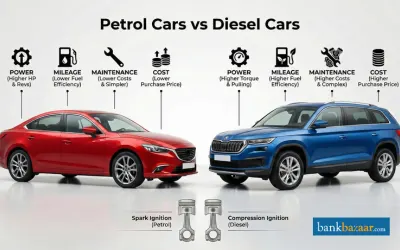
Differences between Petrol and Diesel Cars
The main differences between petrol and diesel cars are mentioned below:
- Refinement: The overall refinement of diesel engines is lacking in terms of noise vibration and harshness levels compared to petrol engines. However, in high-end car models, the diesel engines are so refined that you can hear only a marginal sound of the engine clatter.
If you aren't picky about the sound and vibration of a diesel engine clatter, then you can opt for a diesel engine to power the car of your choice.
- Power: Petrol engines produce better power and low torque whereas diesel engines generate higher power and lower torque. What this essentially means is that a petrol engine gives better initial pick-up but lags when there is a shift to lower gears whereas a diesel engine will take time to during the initial pickup but respond well to acceleration in the midst of driving.
If you prefer a swift initial pick-up in your car, then opt for a petrol engine but if you desire the sudden thrust of power, then go for a diesel engine.
- Mileage: Cars powered by diesel engines deliver superior mileage to petrol cars. Furthermore, the price of petrol is higher than diesel in most states across the country. Clearly, diesel cars preferable for better mileage and lower cost of fuel.
- Maintenance: When it comes to servicing and maintenance of diesel and petrol cars, they come with their own set of pros and cons. If you primarily use your vehicle for short-distance driving, then opt for a petrol car.
Diesel cars are more suited for long-distance driving as it is economical in terms of fuel costs. However, in terms of maintenance, diesel cars have higher servicing and maintenance costs compared to petrol cars.
Car loan for Petrol and Diesel Cars
To purchase a car of your choice, you will need sufficient finance. One way of owning a car of your own is by opting for a car loan. Banks and Non-Banking Financial Companies (NBFCs) offer new and used car loans at competitive interest rates to any individual meeting the car loan eligibility criteria.
Car loans from banks can be used to purchase most makes and models of cars in the market - passenger vehicles, hatchbacks, sedans, compact cars, Sports Utility Vehicles (SUV), Multi-Utility Vehicles (MUV), commercial vehicles, etc. Banks offer a maximum loan amount of up to 85-100% of the on-road price or ex-showroom price of the car. If you make a higher down payment on your car, the cost of your car will be lower.
Important Details to know when Applying for a Car Loan
- Car Loan Eligibility
Any individual aged 21 to 65 years with a good credit score, a steady income, and a stable occupation is eligible for a car loan. A credit of score 750 or above indicates the applicant's creditworthiness.
Having a minimum annual incomes of Rs.2 lakh or more indicates the applicant's capacity to repay the car loan on time. Salaried and self-employed individuals must have minimum 2 years of work experience in the same field in order to show that they have a stable occupation.
- Car Loan Interest Rate
The interest rate of new and used car loans varies depending on the bank. Always compare various car loan offers and choose one with the lowest interest rate and a suitable loan tenure. Interest rate of a car loan also depends on the applicant's credit score, repayment capacity, loan tenure, type of car loan, and type of car.
- Car Loan Tenure
Car loans are repaid in Equated Monthly Installments (EMIs) over a specific period of time called the loan tenure. Banks offer new car loans for a loan tenure ranging from 1 to 7 years and 1 to 5 years for used car loans.
A short car loan tenure means higher EMI payments but shorter loan repayment time. A long car loan tenure means lower EMI payments but longer loan repayment period and considerably higher overall interest payments. Therefore, choose your car loan tenure carefully so as to avoid paying more interest.
- Car Loan EMI Calculator
To calculate your car loan EMI, you can use the free online car loan EMI calculator that is available on the bank website or a reliable third-party website. Calculating your car loan EMI will help you find out how much your car loan costs you monthly.
Using the car loan EMI calculator is simple and easy - just enter the loan amount, loan tenure, interest rate, and processing fee into the tool and click on the 'calculate' button. You will get instant and accurate results in the form an amortisation table which represents the periodic car loan repayment schedule. Calculating your car loan EMI will also help you choose a suitable loan tenure.
- Car Loan Charges
A processing fee of 2% of the principal loan amount is charged up front at the time of loan disbursal by the bank for processing your car loan application. Some banks waive off the processing fee.
After 12 successful EMI payments, banks allow borrowers to make part or full prepayment of the car loan before the end of the loan tenure. However, a prepayment fee is charged on the part or full prepayment amount as a penalty for prepayment/preclosure of the car loan before the end of the loan tenure.
Other charges include stamp duty charges, foreclosure charges, etc. Prepayment is paying a part of the car loan before the end of the loan tenure and preclosure is paying the whole of the car loan before the end of the loan tenure.
Pre-closing a car loan is not advisable as it can affect your credit score and credit history negatively. To improve your credit score, you must make timely EMI payments.
- Car Loan Foreclosure
A car loan is a secured loan wherein your car acts as a collateral. Therefore, if you default on your car loan, the bank will repossess your car and put it up for auction to compensate for the outstanding dues.
The bank will advertise or intimate the details of the auction in print. You can bid for the car yourself if you have sufficient funds. To avoid defaulting on your car loan, maintain a low debt-to-income ratio. Your EMI payments must not exceed more than 50% of your income.
How to apply for a car loan?
With the advent of technology, it has become easier to apply for a car loan online through the bank website with just a few clicks of the mouse from the comfort of your home or office. However, before applying for a car loan, it is wise to check your car loan eligibility so as to avoid rejection.
Multiple loan rejections will affect your credit score negatively. Visit a reliable third-party comparison website to compare various personal loan offers across the top banks and choose one with the lowest interest rate and a suitable repayment period.
To apply for a car loan online - Download a car loan application form from the bank website, fill it up, and submit it along with the necessary documents such as identity proof, age proof, address proof, and income proof. The bank will verify your documents and process your car loan application. Upon approval, the loan amount will be disbursed to your bank account immediately. To apply for a car loan offline, visit the nearest bank branch and seek the help of a bank executive.


Car Loan Articles
- Car Prices in India
- How To Transfer a Car Loan to Another Person
- How GST Affected Car Prices in India
- Car Lease Vs Car Loan
- Car Loan Foreclosure Procedure
- Vehicle Registration
- Car Loan Document Checklist
- Bad Credit Car Loan
- Car Loan Refinancing
- Zero Downpayment Car Loan
- Commercial Car Loan
- Car Loan for Nris
- Car Loan Schemes for Women
- Car Loan Preclosure
- Transfer Car Registration
- Top 10 Banks for Car Loan
- Car Loan Schemes for Government Employees
- Fuel Efficient Sedan Cars
- Automatic Cars for Women
- Chepest Cars in India

Disclaimer
Credit Card:
Credit Score:
Personal Loan:
Home Loan:
Fixed Deposit:


Copyright © 2026 BankBazaar.com.