


8th Pay Commission - Expectations, News and Updates
What is the 8th Pay Commission?
The 8th Pay Commission is a proposed commission in India intended to revise the salary, allowances, and pensionary benefits for all Central Government employees (CGE).
The Union Cabinet has approved the 8Th Pay Commission which will revise the salaries and pensions of central government employees and will be implemented from January 2026.
Table of Contents
- Key Highlights of the 8th Pay Commission
- 8th Pay Commission Overview
- 8th Pay Commission Salary Calculator
- 8th Pay Commission Salary Structure
- Component-Wise Breakdown
- 8th Pay Commission Fitment Factor
- Historical Comparison of Fitment Factors
- Fitment Factor Example
- 8th Pay Commission Salary Calculator
- How to Calculate the Revised Salary
- Summary of Key Changes
- Main Differences Between 7th Pay Commission and 8th Pay Commission
- Impact on CGHS and NPS Contributions
- 8th CPC Salary Increase
- Expected 8th Pay Commission Minimum Basic Salary Table
- Benefits of 8th Pay Commission Implementation
- Will the 8th Pay Commission Replace the 7th CPC?
- 8th Pay Commission ToR Delay

Introduction of the 8th Central Pay Commission not only benefits government employees but also the military personnel and pensioners. The implementation of the 8th CPC will eliminate the disparity between the salaries of different groups of employees and also help them cope with inflation.
Key Highlights of the 8th Pay Commission
Feature | Details |
Announced By | Union Cabinet / Prime Minister Narendra Modi |
Date of Announcement | 16 January 2025 |
Formally Constituted | 3 November 2025 (Gazette Notification) |
Chairperson | Justice Ranjana Prakash Desai |
Members | Prof. Pulak Ghosh; Shri Pankaj Jain, IAS (Member-Secretary) |
Expected Implementation Date | 1 January 2026 (arrears likely if delayed to 2027) |
Report Submission Timeline | Within 18 months of constitution (expected mid-2027) |
Expected Fitment Factor | 1.83 to 3.83 (under discussion, final figure yet to be decided) |
Minimum Basic Pay (7th CPC) | Rs.18,000 |
Expected Minimum Basic Pay (8th CPC) | Rs.41,000 – Rs.51,480 (depending on final fitment factor) |
Minimum Pension (7th CPC) | Rs.9,000 |
Expected Minimum Pension (8th CPC) | 20% – 30% (conservative) to 80%+ (high-end union demand) |
Current Dearness Allowance (DA) | 60% of Basic Pay (effective 1 January 2026) |
8th Pay Commission Overview
Here is the overview of the 8th Pay Commission:
- Implementation Authority: The 8th Central Pay Commission will be managed by the Department of Personnel and Training (DoPT), which is responsible for reviewing pay scales, allowances, and pensions of central government employees.
- Expected Fitment Factor: Reports suggest a fitment factor of 2.28, which could raise the basic pay across all levels. In some projections, this may change further depending on inflation and fiscal conditions.
- Expected Dearness Allowance (DA): The DA was projected to reach around 70 percent by January 2026. Once the new pay commission is implemented, this DA will be merged into the basic salary to recalculate allowances like HRA and TA.
- Implementation Date: The 8th Pay Commission recommendations are targeted for implementation from 1 January 2026. As of May 2026, the Terms of Reference (ToR) have been approved and the commission's work is ongoing, with final recommendations expected within 18 months of formation.
- Minimum Wage Increase: The current minimum pay of Rs.18,000 under the 7th CPC is expected to rise to around Rs.41,000 under the 8th CPC, providing a substantial hike for employees at the entry level.
- Pension Minimum: Pensioners are also expected to benefit, with the minimum pension likely to rise from Rs.9,000 to about Rs.22,500, ensuring improved post-retirement financial security.
- Beneficiaries: The revisions are estimated to impact about 50 lakh central government employees, including defence personnel, and around 65–68 lakh pensioners across India.
- Official Reference: Updates and notifications will be available on the Department of Personnel and Training (DoPT) official website: https://dopt.gov.in/
Title | 8th Pay Commission |
Draft Prepared in the Year | 2023 |
Commission announced | 2024 |
Implementation year | 2026 |
Commission Category | Finance |
Beneficiaries | Employees of Central Government |
8th Pay Commission Salary Calculator
The 8th Pay Commission Salary Calculator is designed to help central government employees and pensioners estimate their revised salary and allowances once the recommendations are implemented. Since the new pay scales will depend on the fitment factor, allowances, and city classification, the calculator provides an approximate projection of gross earnings.
8th Pay Commission Regional Consultation Meetings
The Commission has been conducting regional consultation meetings across the country to collect salary revision proposals and pension-related demands from employee federations, unions, and government bodies.
Location | Dates |
New Delhi | 28 April 2026 – 30 April 2026 |
Hyderabad, Telangana | 18 May 2026 – 19 May 2026 |
Srinagar and Jammu & Kashmir | 1 June 2026 – 4 June 2026 |
Ladakh | 8 June 2026 |
Lucknow, Uttar Pradesh | 22 June 2026 – 23 June 2026 |
8th Pay Commission Salary Structure
The three main components of the 8th Pay Commission are mentioned below:
- Basic Pay: The revised basic salary, calculated by applying the fitment factor to the current 7th CPC basic pay.
- Allowances: Key allowances, including Dearness Allowance (DA), House Rent Allowance (HRA), and Travel Allowance (TA), will be recalculated based on the revised basic pay.
- Gross Salary: The total of all components above, reflecting overall remuneration under the new structure.
Component-Wise Breakdown
Component | Details |
Basic Pay | Current Basic Pay × Fitment Factor |
Dearness Allowance (DA) | % of revised Basic Pay (resets to 0% on implementation) |
House Rent Allowance (HRA) | 27% (Metro) / 20% (Tier-2) / 10% (Tier-3) of revised Basic Pay |
Travel Allowance (TA) | Varies by pay level and city category |
8th Pay Commission Fitment Factor
The fitment factor is the central multiplier used to convert an employee's pre-revised basic pay into the revised pay structure. It directly determines the size of salary and pension hikes across all levels.
Historical Comparison of Fitment Factors
Pay Commission | Hike in Pay (%) | Fitment Factor | Minimum Basic Salary |
4th Pay Commission | 27.6% | - | Rs.750 |
5th Pay Commission | 31% | - | Rs.2,550 |
6th Pay Commission | 54% | 1.86 | Rs.7,000 |
7th Pay Commission | 14.29% | 2.57 | Rs.18,000 |
8th Pay Commission | 20–30% (estimated) | 1.83–3.83 (under discussion) | Rs.41,000–Rs.51,480 (projected) |
Fitment Factor Example
If a fitment factor of 2.86 is adopted:
- Level 1 minimum basic pay: Rs.18,000 × 2.86 = Rs.51,480
- Level 10 minimum basic pay: Rs.56,100 × 2.86 = Rs.1,60,446
If a fitment factor of 3.00 is adopted (as demanded by several employee unions for Levels 1–5):
- Level 1 minimum basic pay: Rs.18,000 × 3.00 = Rs.54,000
Expected 8th Pay Commission Pay Matrix and Salary Hike Table:
The table below shows the projected salary range under the 8th CPC across all pay matrix levels. As the fitment factor has not been finalised, a range is presented.
Pay Matrix Level | 7th CPC Basic Pay (Rs.) | Estimated 8th CPC Basic Pay Range (Rs.) |
Level 1 | 18,000 | 32,940 – 69,000 |
Level 2 | 19,900 | 36,467 – 76,000 |
Level 3 | 21,700 | 39,731 – 83,000 |
Level 4 | 25,500 | 46,715 – 97,000 |
Level 5 | 29,200 | 53,456 – 1,11,000 |
Level 6 | 35,400 | 64,782 – 1,35,000 |
Level 7 | 44,900 | 82,167 – 1,72,000 |
Level 8 | 47,600 | 87,108 – 1,82,000 |
Level 9 | 53,100 | 97,173 – 2,03,000 |
Level 10 | 56,100 | 1,02,663 – 2,15,000 |
Level 11 | 67,700 | 1,23,891 – 2,59,000 |
Level 12 | 78,800 | 1,44,204 – 3,02,000 |
Level 13 | 1,23,100 | 2,25,273 – 4,71,000 |
Level 13A | 1,31,100 | 2,39,913 – 5,02,000 |
Level 14 | 1,44,200 | 2,63,886 – 5,52,000 |
Level 15 | 1,82,200 | 3,33,426 – 6,98,000 |
Level 16 | 2,05,400 | 3,75,882 – 7,87,000 |
Level 17 | 2,25,000 | 4,11,750 – 8,62,000 |
Level 18 | 2,50,000 | 4,57,500 – 9,57,000 |
8th Pay Commission Salary Calculator
The 8th Pay Commission Salary Calculator helps central government employees estimate their revised salary and allowances once the recommendations are implemented. Since the new pay scales will depend on the final fitment factor, allowances, and city classification, any figure should be treated as a projection.
How to Calculate the Revised Salary
The process that must be followed to calculate the revised salary under the 8th Pay Commission is mentioned below:
- Identify your current basic pay: Find your current basic pay on your salary slip (under the 7th CPC). For example: Rs.18,000.
- Apply the fitment factor: Multiply your current basic pay by the expected fitment factor.
Revised Basic Pay = Current Basic Pay × Fitment Factor Example: Rs.18,000 × 2.86 = Rs.51,480
- Add Dearness Allowance (DA): When the 8th CPC is implemented, existing DA will be merged into the new basic pay, and DA will reset to zero. Future DA increases will be calculated on the revised base. For estimation purposes:
DA = Revised Basic Pay × DA Rate Example (at 0% post-reset): Rs.51,480 × 0% = Rs.0
- Add House Rent Allowance (HRA): HRA is based on city classification:
- Metro cities: 27% of revised basic pay
- Tier-2 cities: 20% of revised basic pay
- Tier-3 cities: 10% of revised basic pay
Example (Metro): Rs.51,480 × 27% = Rs.13,899
- Add Travel Allowance (TA): TA varies by pay level and city. Assume approximately Rs.5,400 for Level 1, Metro.
- Calculate Gross Salary: Add all of the above to get the gross salary, which is around Rs.70,799.
Summary of Key Changes
- Fitment factor: Expected to be significantly higher than the 7th CPC's 2.57, providing greater salary relief.
- Minimum wage: The entry-level minimum pay could more than double, providing meaningful relief for Group C employees.
- Consultation process: The 8th CPC has a more structured public participation process, including an online portal, MyGov questionnaire, and regional consultation meetings.
- Wider economic context: The 8th CPC is being formulated at a time of higher inflation compared to 2016, which makes the fitment factor discussion more critical.
Main Differences Between 7th Pay Commission and 8th Pay Commission
The main differences between the 7th Pay Commission and 8th Pay Commission are mentioned below:
Parameter | 7th Pay Commission | 8th Pay Commission |
Year of Announcement | September 2013 | January 2025 |
Year of Constitution | February 2014 | November 2025 |
Implementation Date | 1 January 2016 | 1 January 2026 (expected) |
Fitment Factor | 2.57 | 1.83–3.83 (under discussion; likely 2.86+) |
Minimum Basic Pay | Rs.18,000 | Rs.41,000–Rs.54,000 (estimated) |
Minimum Pension | Rs.9,000 | Rs.22,500–Rs.27,000 (estimated) |
Pay Structure | Replaced Grade Pay with Pay Matrix | Expected to revise the existing Pay Matrix |
DA Rate at Implementation | Merged into basic pay | Expected to reset to 0% once merged |
Salary Hike | Around 14.29% | 20–30% (conservative estimate); up to 80%+ (union demand) |
NPS Contribution (Government) | 10% of Basic + DA | 14% of Basic + DA (already revised; will rise with pay) |
Annual Increment | 3% of basic pay | 7% demanded (not yet confirmed) |
Family Unit for Minimum Wage | 3 members | 5 members demanded (not yet confirmed) |
Fixed Medical Allowance (Non-CGHS areas) | Rs.1,000/month | Rs.20,000/month demanded (not yet confirmed) |
Beneficiaries (Serving Employees) | Around 48 lakh | Around 49 - 50 lakh |
Beneficiaries (Pensioners) | Around 55 lakh | Around 65 - 68 lakh |
Impact on CGHS and NPS Contributions
Central Government Health Scheme (CGHS)
- CGHS subscription rates are linked to salary levels. As basic pay rises, employees will see higher CGHS deductions.
- Pensioners in non-CGHS areas currently receive a Fixed Medical Allowance of Rs.1,000 per month. Employee unions have demanded this be raised to Rs.20,000 per month, a demand that is under active consideration.
National Pension System (NPS)
- Employees currently contribute 10% of Basic Pay + DA, whilst the government contributes 14%.
- Once salaries rise under the 8th CPC, both employee and government contributions will automatically increase in proportion.
- This will improve long-term retirement savings for employees under the NPS framework.
8th CPC Salary Increase
For all Central Government employees, the 8th Pay Commission is expected to suggest a revision in the basic salary, which may fall between approximately 25% to 35%. The 8th Pay Commission will also suggest a significant increment in the retirement benefits of up to 30%.
Expected 8th Pay Commission Minimum Basic Salary Table
The following is the list of minimum basic salary of expected 8th Pay Commission:
Pay Matrix Level | Basic Salary of 7th CPC | Basic Salary of 8th CPC |
Pay Matrix Level 1 | Rs.18,000 | Rs.21,600 |
Pay Matrix Level 2 | Rs.19,900 | Rs.23,880 |
Pay Matrix Level 3 | Rs.21,700 | Rs.26,040 |
Pay Matrix Level 4 | Rs.25,500 | Rs.30,600 |
Pay Matrix Level 5 | Rs.29,200 | Rs.35,040 |
Pay Matrix Level 6 | Rs.35,400 | Rs.42,480 |
Pay Matrix Level 7 | Rs.44,900 | Rs.53,880 |
Pay Matrix Level 8 | Rs.47,600 | Rs.57,120 |
Pay Matrix Level 9 | Rs.53,100 | Rs.63,720 |
Pay Matrix Level 10 | Rs.56,100 | Rs.67,320 |
Pay Matrix Level 11 | Rs.67,700 | Rs.81,240 |
Pay Matrix Level 12 | Rs.78,800 | Rs.94,560 |
Pay Matrix Level 13 | Rs.1,23,100 | Rs.1,47,720 |
Pay Matrix Level 13 A | Rs.1,31,100 | Rs.1,57,320 |
Pay Matrix Level 14 | Rs.1,44,200 | Rs.1,73,040 |
Pay Matrix Level 15 | Rs.1,82,200 | Rs.2,18,400 |
Pay Matrix Level 16 | Rs.2,05,400 | Rs.2,46,480 |
Pay Matrix Level 17 | Rs.2.25 lakh | Rs.2.70 lakh |
Pay Matrix Level 18 | Rs.2.50 lakh | Rs.3 lakh |
Benefits of 8th Pay Commission Implementation
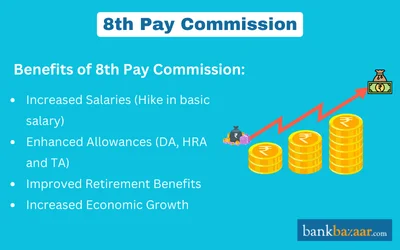
For Central Government Employees:
- Increased Salaries: The most anticipated benefit is a hike in basic salary, estimated between 25% and 35%. This can improve living standards and provide greater financial security.
- Enhanced Allowances: To account for inflation and shifting living expenditures, the commission may revise several benefits, including the Dearness Allowance (DA), House Rent Allowance (HRA), and Transport Allowance (TA).
- Improved Retirement Benefits: An increase in pension could offer better financial security after retirement, with estimates suggesting up to a 30% increase.
- Boosted Morale and Motivation: Taking care of financial issues may increase worker satisfaction and even boost output.
For the Indian Economy:
- Increased Spending: Government workers are likely to spend more when they have greater disposable income, which will boost demand for products and services and boost the economy.
- Tax Revenue Growth: Increased salary may result in increased tax income for the government.
- Reduced Financial Stress: Employee financial well-being can lessen the strain on social welfare programs and improve societal stability.
Will the 8th Pay Commission Replace the 7th CPC?
Yes, the 8th Central Pay Commission will soon replace the 7th Central Pay Commission by revising the pay scales, allowances, and pension benefits every ten years for all Central government employees and pensioners.
The 7th CPC was established in 2014 and took effect on 1 January 2016. While the 8th CPC will be established in 2024 and will be implemented on 1 January 2026 by bringing about a change in pay scales among the government employees and boosting the retirement benefits by 25%.
8th Pay Commission ToR Delay
The Terms of Reference (ToR) specify the scope and responsibilities of each Pay Commission. While the announcement of a commission is the first step, the actual work begins only after the government issues the ToR. Historically, there has always been a gap between announcement and formal notification.
Here’s a look at the timelines of past commissions:
- 4th Pay Commission – Announced on 26 July 1983 and notified on 1 September 1983, with a delay of about one month.
- 5th Pay Commission – Announced on 1 September 1993, but the notification came on 9 April 1994, resulting in a delay of more than seven months.
- 6th Pay Commission – Announced on 20 July 2006 and notified on 5 October 2006, with a gap of around two and a half months.
- 7th Pay Commission – Announced on 25 September 2013, followed by notification on 28 February 2014, creating a delay of five months.
- 8th Pay Commission – Announced on 16 January 2025. The Terms of Reference (ToR) were subsequently approved by the Cabinet (as reported in October 2025). The commission is working on its recommendations, expected to be submitted within 18 months of formation.
Key Takeaway
The 8th Pay Commission has already seen one of the longest delays in issuing its ToR compared to earlier commissions. This prolonged gap is causing uncertainty among employees and pensioners, as the commission cannot begin formal work until the notification is released.
FAQs on 8th Pay Commission
1.When will the 8th Pay Commission be implemented?
The 8th Pay Commission is expected to be implemented on 1 January 2026.
2.Is the 8th Pay Commission applicable to pensioners?
The 8th Pay Commission is applicable to pensioners as well. Pensioners will get their pension revised in accordance with the recommendations of the 8th Pay Commission ensuring the same formula is applied to the revision of pension based on the salary revision.
3. How much will the pension increase after the 8th Pay Commission?
The pension increases under the 8th pay commission is likely to be around 20%. The increase will again be made considering the same fitment and revision process as its salary increases which would assist retired employees to improve their financial security in line with their active counterparts.
4.Why delay in 8th Pay Commission?
The delay in announcing the 8th pay commission is due to the fact that some form of consultations, economic assessments and budgetary implications are still being reviewed.
5.What will be the salary in 8th Pay Commission?
The basic salary in the 8th Pay Commission will be Rs.25,000 approximately, after implementation of the 8th CPC.
6.What is the expected increase in salary for 8th pay commission?
The salary under the 8Th Pay Commission is expected to increase by approximately 20%.
7.Is there any proposal to implement an Auto Pay Revision System for Central Government employees?
No, there is no proposal to implement an Auto Pay Revision system as of now for the employees under Central Government.
8.Is there possible to constitute the 8th pay commission?
Yes, the 8th Pay Commission has been constituted. It was announced on 16 January 2025, with the Terms of Reference approved by the Cabinet. Feedback from stakeholders was invited through 16 March 2026.
9.What is the 8th Pay Commission salary slab?
There is no fixed salary slab in the 8th Pay Commission as of now and it will be calculated by determining the minimum pay based on the 15th ILC norms and Dr. Aykroyd Formula, through the utilisation of wage rate index in the 2025.
10.When DA hits 50%, what happens?
The daily stipend, rental allowance, hostel subsidy, and other related allowances will rise if the DA exceeds 50%. It happens because these allowances are correlated with the DA, meaning that they rise in tandem with the DA.
11.Is the 8th Pay Commission applicable to state government employees?
No, the 8th Pay Commission covers Central Government employees and pensioners only.
12.Is the 8th Pay Commission applicable to bank employees?
No, bank employees follow industry-level wage settlement agreements negotiated separately between banks and employee unions.
13.What happens to NPS contributions after the 8th Pay Commission?
NPS contributions are calculated as a percentage of Basic Pay + DA. As salaries rise under the 8th CPC, both the employee's contribution (10%) and the government's contribution (14%) will automatically increase proportionally, improving long-term retirement savings.
Latest 8th Pay Commission Updates
8th Pay Commission Website Launched
The government has officially rolled out the 8th Pay Commission website following the commission’s formation. Through the new platform, the ministries, departments, central government employees, and pensioners can share their feedback on salaries and pensions.
The feedback is to be made before 16 March 2026, and the online questionnaire with 18 questions has been made available on the MyGov portal. The responder’s identity will remain confidential, and all responses will be analysed collectively. A wide range of people linked to government services, including court officials, researchers, academicians, authorised nodal officers from government offices, and individual citizens, are eligible to provide feedback. The new portal has been launched with the aim of seeking inputs and collecting responses in a systematic manner.
Government Likely to Announce Implementation Timeline for 8th Pay Commission Soon
The 8th Pay Commission's terms of reference, which will benefit 69 lakh retirees and 50 lakh central government employees, has been approved by the Cabinet. The suggestions made by the Eighth Pay panel are expected to be implemented on 1 January 2026, and they will be submitted within 18 months. Every 10 years, the Center typically forms a pay commission to review government employees' compensation.
In February 2014, the 7th Pay Commission was established, and on 1 January 2016, its recommendations were put into effect. Dearness Allowance (DA) is given to central government employees in order to compensate for the decline in the real value of their salary due to inflation. The rate of DA is adjusted every six months based on the rate of inflation.

Disclaimer
Credit Card:
Credit Score:
Personal Loan:
Home Loan:
Fixed Deposit:


Copyright © 2026 BankBazaar.com.