


Car Insurance
Your financial safety net is car insurance, which helps to pay expenses in the event that your vehicle is stolen, destroyed, or involved in an accident. It is meant to shield you from unforeseen costs and provide your legal protection. In India, to legally drive on road, it is mandatory to have a car insurance policy as per the Motor Vehicles Act, 1988.

What is Car Insurance?
Car insurance is a sort of vehicle insurance that covers you against unexpected expenses caused by accidents, theft, natural catastrophes, or third-party damage. By covering replacements, repairs, and legal obligations, it lessens the financial strain on car owners.
Key Features of Car Insurance Policy
Listed below are the key features of a car insurance policy:
1. Comprehensive & Third-Party Coverage: Car insurance provides coverage for third-party liabilities, such as injury or property damage caused to others, along with own damage protection for your vehicle in case of accidents, theft, fire, vandalism, or natural disasters. A comprehensive policy combines both, offering more extensive protection.
2. Add-on Covers for Enhanced Protection: Insurers provide a range of optional add-ons such as zero depreciation, engine protection, NCB protect, roadside assistance, windshield protection, towing assistance, and consumables cover, allowing you to customize your policy.
3. Personal Accident Cover: Provides financial coverage of up to ₹15 lakh in case of accidental death or permanent disability of the owner-driver, offering essential personal safety.
4. Affordable Premiums: Car insurance premiums start as low as ₹2094*, depending on the car, location, coverage type, and add-ons selected.
5. No Claim Bonus (NCB): Policyholders are rewarded with up to 50% discount on their premium for every claim-free policy year, promoting safe and responsible driving.
6. Discounts & Savings: Additional discounts are available for installing anti-theft devices, having ARAI membership, opting for higher voluntary deductibles, and maintaining a clean claim history.
7. Voluntary Deductibles: You can reduce your premium by choosing to pay a fixed portion of claim costs out-of-pocket. Higher deductibles lead to lower premium amounts.
8. Legal Liability Coverage: Offers protection against legal expenses in case you're held liable for third-party injuries, death, or property damage following an accident.
9. Easy Online Process: The entire buying and renewal process is online, making it fast, simple, and paperless for policyholders.
10. Cashless Repairs Across Network Garages: Access to a wide network of cashless garages enables hassle-free repairs without upfront payment, saving you time and effort during claims.
Benefits of Car Insurance Policy
The following is the list of benefits of a car insurance policy:
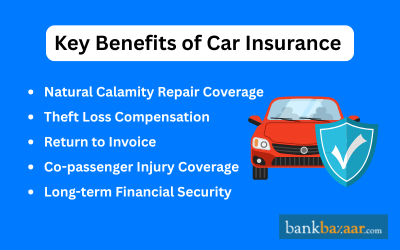
1. Protection Against Natural Calamities: Car insurance safeguards you from financial losses caused by natural disasters like floods, earthquakes, cyclones, and storms by covering repair or replacement costs.
2. Protection Against Theft: If your car is stolen, the insurer compensates you with the Insured Declared Value (IDV), reducing your financial burden significantly.
3. Return to Invoice Cover: This add-on ensures reimbursement of the full invoice value of your car (including taxes and registration fees) in case of total loss or theft—ideal for new or high-value cars.
4. Coverage for Co-passengers: Some policies extend accident-related coverage to passengers, providing financial protection for medical expenses or compensation in case of injury or death.
5. Financial Security: Car insurance provides a safety net against major out-of-pocket expenses related to repairs, legal claims, or medical emergencies—offering long-term financial stability.
6. Peace of Mind: The overall benefit is the peace of mind it brings—knowing you're covered in the event of theft, accident, or natural disaster allows for confident, stress-free driving.
Types of Car Insurance Policies
Mentioned below are the various types of car insurance policies to help you choose the right coverage:
1. Comprehensive Car Insurance Policy
Both your personal vehicle damage and third-party liabilities are covered by a comprehensive auto insurance policy. This plan offers more comprehensive financial protection, regardless of the cause—accidents, theft, fire, or natural disasters like earthquakes and floods. Add-ons like return-to-invoice benefits, engine security, and roadside assistance can also improve coverage.
2. Policy for Stand-Alone Own Damage Car Insurance
To cover your own vehicle from theft, accidents, natural catastrophes, and man-made disasters, you can buy standalone own damage auto insurance separately if you already have a third-party insurance policy. Additionally, it allows auto owners to personalize the coverage by adding optional extras for better security.
3. Third-Party Car Insurance
According to the Motor Vehicles Act of 1988, this is the most fundamental and legally required policy. It covers any harm your car causes to another person, vehicle, or piece of property. In addition to covering property damage up to Rs.7.5 lakhs, the third-party car insurance plan covers bodily injury and even death. It does not, however, cover harm to your own vehicle.
4. Policy for Car Insurance with Zero Depreciation
This zero-depreciation auto insurance add-on, also known as a zero dep or bumper-to-bumper policy, guarantees that you receive the entire claim amount for repairs and replacements without deductions for depreciation on metal, rubber, or plastic parts like batteries. For new cars or expensive models with high repair expenses, it is strongly advised.
5. Usage-Based Car Insurance
This contemporary usage-based low-cost auto insurance plan is intended for people who do not drive frequently. Odometer readings are used to determine the premium, which is determined by how much you drive. It guarantees that you only pay for what you use, making it the perfect option for weekend drivers, work-from-home workers, and car owners with little usage.
Car Insurance Add-on Covers & Options
Here are the add-on covers and options available with car insurance policies:
- Engine Protection: Covers damage to the engine caused by external factors like water ingress or oil leakage.
- Roadside Assistance: Offers immediate help in case of breakdowns, including towing and minor repairs.
- Consumables Cover: Pays for consumables such as lubricants and bolts used during vehicle repairs.
- Key Replacement: Covers the cost of replacing lost or stolen keys.
- Return to Invoice Cover: Provides compensation equal to the car's original invoice price if it is deemed a total loss.
- No Claim Bonus (NCB) Protection: Getting this cover keeps your NCB intact.
- Road Assistance: This cover offers help during breakdowns, towing, battery-jump start and other similar scenarios.
- Daily Cash Allowance: Covers transportation costs if the vehicle is in a garage for 3–4 days, though less common due to shorter repair times.
- Key Replacement: Compensates for expenses related to replacing lost or misplaced car keys, often covering only partial costs.
What is Covered Under a Car Insurance Policy?
The Policy Wordings provide an explicit list of coverage:
1. Coverage for Third-party Car Insurance:
- Injuries to third parties
- Death of a third party
- Damage to third-party property
2. Complete Coverage for Car Insurance:
- Injuries to third parties
- Death of a third party
- Damage to third-party property
- Theft
- Flames
- Disasters
- Accident-related damage to the vehicle
What is Not Covered Under a Car Insurance Policy?
This is a list of things that an auto insurance policy does not cover. See the corresponding Policy Wordings for a detailed list of exclusions:
- Driving while intoxicated
- Driving while under the influence of alcohol
- Operating a vehicle without a proper license
- Operating a vehicle without a current auto insurance policy
- Damages in times of conflict
- Costs of servicing
How to Buy Car Insurance Online?
To buy a car insurance online follow the steps mentioned below -
Step 1: Research and select the car insurance provider that best suits your needs.
Step 2: Visit the car insurance provider’s website and pick the best plan for yourself.
Step 3: Once you select the plan, follow the steps of filling all the necessary details asked by the website.
Step 4: Submit the form and proceed to the online payment page.
Step 5: Complete the payment with your credit or debit card.
Step 6: After the payment is done, you will get the policy document from the insurer through your registered email id.
How to Renew Car Insurance Online?
Given below are the steps to renew your car insurance online:
Step 1: Visit the car insurance renewal section of your insurer.
Step 2: Enter the details like your name, date of birth, policy number, etc., and submit.
Step 3: Select the car insurance plan you wish to buy.
Step 4: Choose the add-on covers or riders that you wish to purchase (if required).
Step 5: The premium amount payable will be displayed on the screen.
Step 6: Make the premium payment via net banking, debit card, or credit card.
Step 7: Your car insurance will be renewed after you complete the payment.
Factors Affecting Car Insurance Premium
The premium for a car insurance policy is calculated based on the following factors:
- Insured Declared Value (IDV): The higher the IDV of your car, the higher the insurance premium.
- Safety Features: Installing approved anti-theft devices or other safety features may help you to get premium discounts.
- Age of the Vehicle: Older vehicles generally have a lower IDV, which may result in a lower premium.
- Location of Registration: Premiums are different based on the city or region where the car is registered, as accident and theft risks vary by location.
- Voluntary Deductible: If you choose a higher voluntary deductible, then it can reduce your insurance premium.
- Car Make, Model, and Variant: Premiums also depend upon the vehicle's make, model, engine capacity, and repair costs.
- Type of Coverage: Comprehensive policy cost more than third-party policiey, and if you add optional covers, then the amount gets increased further.
- No Claim Bonus (NCB): A claim-free policy year earns you an NCB, which reduces the premium at renewal.
Why Do You Need a Car Insurance?
The following are the reasons for Car Insurance:
- Mandatory by Law: The Motor Vehicles Act, 1988, requires car insurance for all vehicles in India. Non-compliance can lead to penalties and suspension of driving rights.
- Protection for You and Your Vehicle: Comprehensive insurance covers damage to your vehicle, third-party damages, and incidents like fire, natural disasters, or vandalism.
- Financial Protection for Your Family: Personal accident cover in car insurance offers monetary compensation to the policyholder or their family in the event of death or serious injury resulting from an accident.
- Coverage for Legal Expenses: Car insurance helps cover legal costs incurred due to an accident, easing the financial burden of legal proceedings.
- Third-Party Liability Coverage: A standard third-party insurance policy covers expenses related to injuries or property damage caused to others, including medical and repair costs.
How to Calculate Car Insurance Premium?
There are various factors that the insurance provider takes into account while calculating the car insurance premium. These factors are mentioned below -
- Type of car
- Age of car
- Geographical zone
- Insured Declared Value (IDV) of the car
- Cubic capacity of the engine Regional Transport Office
Car Insurance Claim Process for Damages to Your Own Car
For damage occurred to your car, the car insurance claim process is as follows:
- Step 1: Report the theft at the nearest police station as soon as possible and obtain an FIR that includes all necessary details about the incident and your vehicle.
- Step 2: Contact your insurance company and inform them about the theft. Share a copy of the FIR, vehicle details such as make, model, and registration number, along with any witness information if available.
- Step 3: The insurer will review your claim by examining the FIR and may conduct an investigation, which could include speaking to witnesses and verifying the facts.
- Step 4: Submit Documentation Provide required documents like the FIR, vehicle RC, driving license, car keys (if available), and any other insurer requests.
- Step 5: Loss Assessment The insurer calculates the claim amount based on the vehicle’s Insured Declared Value (IDV) and depreciation.
- Step 6: Claim Settlement The insurer processes the claim and settles it, minus any applicable deductible.
Car Insurance Claim Process for Third Party Claims
The car insurance claim process for a third-party claim is as follows:
Third-party motor insurance claim for disability, injury, or death:
Step 1: File an FIR with the police immediately after the accident and obtain a copy.
Step 2: Get the third-party motor insurance details from the car owner.
Step 3: Obtain a copy of the charge sheet filed by the police against the car owner.
Step 4: Hire a motor claims lawyer and file a compensation case in the Motor Accident Claims Tribunal.
Step 5: The case must be filed in the tribunal court where the accident occurred or where you reside.
Step 6: Out-of-court settlement may be proposed, but involving authorities is advised.
Third-party car insurance compensation claims for property damage:
Step 1: File an FIR and get a copy, along with the charge sheet.
Step 2: File the claim in the local tribunal court.
Step 3: Compensation will be assessed based on submitted documents and statements.
Step 4: The maximum compensation limit for property damage is Rs. 7.50 lakh.
Car Insurance Claim Process for Stolen Car
The car insurance claim process for stolen car is as follows:
- Step 1: File a Police Report Report the theft immediately at the police station and get an FIR with details of the theft and vehicle.
- Step 2: Inform Your Insurance Company Notify your insurer with the FIR, vehicle details (make, model, registration), and any available witness info.
- Step 3: Insurer’s Investigation The insurer will verify the claim, investigating the FIR and possibly interviewing witnesses.
- Step 4: Submit Documentation Provide required documents like the FIR, vehicle RC, driving license, car keys (if available), and any other insurer requests.
- Step 5: Loss Assessment The insurer calculates the claim amount based on the vehicle’s Insured Declared Value (IDV) and depreciation.
- Step 6: Claim Settlement The insurer processes the claim and settles it, minus any applicable deductible.
Documents Required for Filing a Car Insurance Claim
The following is the list of documents required for filling a car insurance claim:
- Duly filled and signed claim form
- Copy of the car insurance policy
- Registration Certificate (RC) of the vehicle
- Valid driving licence of the driver
- FIR (First Information Report), if required (mandatory in cases such as theft, third-party injury/death, or major accidents)
- Repair estimates and original bills from the authorized garage (for reimbursement claims)
- Photographs of the damaged vehicle, if requested
- Form 28, 29,30 and 35 in case of theft claim
Note: The exact document requirements may vary depending on your insurer and the type of claim (cashless, reimbursement, theft, or third-party claim). Therefore, notify your insurer immediately after the incident and submit all required documents instantly in order to avoid any delay.
Popular Car Insurance Companies in India 2026
You can compare leading car insurance providers in India based on their cashless network garages and claim settlement ratios (CSR) to make an informed decision:
Insurance Company | Network Garagesy | Claim Settlement Ratio (CSR) |
Bajaj General Insurance Limited | 7,200+ | 98.5% |
ICICI Lombard General Insurance Co., Ltd. | 12,000+ | 96.75% |
The New India Assurance Co. Ltd. | 3,000 | 95% |
Go Digit General Insurance Limited. | 10,000+ | 96% |
National Insurance Co. Ltd. | 3,100 | 93% |
SBI General Insurance Co. Ltd. | 8,700 | - |
IndusInd General Insurance | 8,200 | 98% |
Also, Know about
FAQs on Car Insurance
1.What is the difference between third-party and comprehensive car insurance?
Third-party insurance covers liability for damages caused to others, while comprehensive insurance includes both third-party coverage and protection for your own vehicle against accidents, theft, and natural disasters.
2.How to calculate car insurance premiums?
Premiums are based on factors like car model, age, location, coverage type, and the driver’s record. Use an online calculator to estimate the cost based on these variables.
3.What is ‘No Claim Bonus’?
No Claim Bonus (NCB) is a discount on your premium for not filing any claims during the previous policy year. It can reduce your premium by up to 50%.
4.What is Zero Depreciation Cover?
Zero Depreciation Cover ensures full claim settlement without deducting depreciation, making it ideal for new cars or expensive parts.
5.What is the process of getting a repair estimate under insurance?
Notify the insurer, provide vehicle damage details, and get an estimate from a network garage. The insurer may send a surveyor to assess the damage.
6.Can I get medical cover for bodily harm or demise of the passenger(s) commuting in my car? Should I buy a separate cover for that?
Third-party insurance covers injuries to others, but for passengers in your car, you may need personal accident cover or comprehensive insurance.
7.What is meant by policy term in car insurance?
The policy term is the duration your car insurance is valid, typically one year, after which you need to renew the policy.
8.My car insurance policy has expired. Will my NCB be retained?
Yes, you can retain your NCB if the policy is renewed within 90 days of expiry. After that, you lose the benefit.
9.What must I do if I lose my insurance policy?
In case you lose your original insurance policy, you must request a duplicate from your insurer or download a soft copy from the insurer’s website if purchased online.
10.What is the PUC Certificate validity for new cars in India?
For new cars, the Pollution Under Control (PUC) certificate is valid for one year. Older cars require quarterly renewal.
11.My car insurance policy application was rejected. What do I do?
You can apply to another insurer or opt for third-party insurance, which is mandatory for all vehicles in India.
12.Can I change my car insurance provider?
Yes, you can switch providers during renewal. Ensure the No Claim Bonus is transferred to the new insurer.
13.Does car insurance cover natural disasters?
Comprehensive insurance covers damage from natural disasters, while third-party insurance does not.

Disclaimer
Credit Card:
Credit Score:
Personal Loan:
Home Loan:
Fixed Deposit:


Copyright © 2026 BankBazaar.com.