


Top 5 Recurring Deposit Calculators to Plan Your Savings
Planning for future financial goals like education, marriage, or building an emergency fund requires a reliable and disciplined savings approach. A Recurring Deposit is one of the safest and most structured ways to grow your money over time.

Why Use a Recurring Deposit Calculator?
A Recurring Deposit (RD) calculator is a financial planning tool that helps you estimate the maturity amount, total interest earned, and the final payout based on your monthly deposit, interest rate, and tenure.
Whether you're saving for education, marriage, emergency funds, or retirement, an RD calculator makes your goal-based savings transparent, realistic, and trackable.
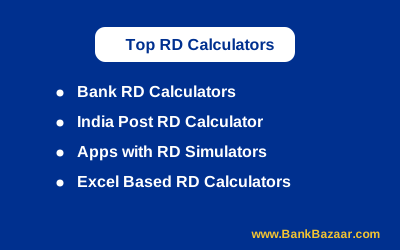
Top 5 RD Calculators to Help You Plan Your Savings
Below are five highly reliable and user-friendly RD calculators that can guide you in smart savings planning.
1. Bank RD Calculators (e.g., SBI, HDFC, ICICI)
Most leading banks provide their own RD calculators, allowing users to simulate returns based on their latest interest rates. Features include:
- Custom tenure selection
- Automatic rate updates
- Breakdown of total interest earned
Best for: Bank-specific RD planning with accurate interest figures
2. India Post RD Calculator
Ideal for those using Post Office RD schemes, this calculator helps plan deposits as low as ₹100/month. It considers the current 5-year interest rate fixed by the Government of India.
Best for: Users interested in small savings or government-backed RDs
3. Mobile Banking Apps with RD Simulators
Most major mobile banking apps now include integrated RD planning tools:
- Real-time maturity value display
- Easy comparison with FDs or SIPs
- Option to directly open an RD from the results
Best for: Tech-savvy users looking for quick access and RD setup
4. Online RD Planning Tools by Financial Portals
Independent financial portals provide free RD calculators that allow:
- Multiple bank comparisons
- Customizable deposit frequency
- Visual maturity charts
Best for: Comparing RDs across banks and optimizing your savings strategy
5. Excel-Based RD Calculators
If you prefer offline tools, Excel templates let you calculate RD maturity manually by entering:
- Principal per month
Tenure in months
- Compounded interest rate
Best for: Finance professionals and those wanting full control over the math

How an RD Calculator Works
An RD calculator uses the formula: M = R × [(1 + i)^n – 1] / (1 – (1 + i)^–1/3) Where:
- M = Maturity amount
- R = Monthly deposit
- i = Rate of interest / 400
- n = Number of quarters
But no need to do the math—just input your values in the calculator to get instant results.
Why RD Calculators Are Useful
- Financial Planning: Know exactly how much you’ll have after your RD matures
- Goal Alignment: Choose deposit amounts based on life goals like education or marriage
- Interest Tracking: Understand how interest is calculated and taxed
- Comparison Tool: Evaluate which bank offers better returns for your needs


FAQs on Top RD Calculators
- What is a Recurring Deposit calculator?
It’s a tool that helps you estimate the maturity value of your RD based on monthly deposit, interest rate, and tenure.
- Are RD calculators accurate?
Yes, especially if you use calculators provided by banks or government-backed institutions. They reflect current interest rates.
- Is interest from RD taxable?
Yes. Interest earned on RD is taxable under "Income from Other Sources" and may attract TDS if above ₹40,000/year (₹50,000 for senior citizens).
- Can I use RD calculators for different banks?
Yes. Many online calculators let you compare RDs across multiple banks by adjusting the interest rate field.
- What is the ideal tenure for RD to meet long-term goals?
For goals like education or marriage, a tenure of 3–10 years is commonly recommended.
- Do RD calculators account for compounding?
Yes. Most calculators consider quarterly compounding, which is the standard method used by banks.

Disclaimer
Credit Card:
Credit Score:
Personal Loan:
Home Loan:
Fixed Deposit:


Copyright © 2026 BankBazaar.com.