


Recurring Deposit for Small Businesses
Recurring Deposits are a low-risk, high disciplined savings option that suits the dynamic needs of small businesses. Whether it's to save for taxes, upgrade equipment, or build financial stability, RDs offer a predictable, structured way to grow surplus funds.

What is a Recurring Deposit (RD)?
A Recurring Deposit is a fixed monthly investment where a business deposits a set amount over a predetermined period — typically between 6 months to 10 years — and earns compound interest.
Key Features:
- Monthly contributions
- Fixed interest rates
- Tenure flexibility
- Interest compounded quarterly (in most banks)
- Premature withdrawal facility (with conditions)
How RDs Help Small Businesses
Benefit | Why It Matters for Small Businesses | |||
Low Risk Investment | Capital remains safe with fixed returns | |||
Easy Cash Flow Planning | Helps save systematically | |||
Goal-Based Saving | Ideal for tax payments, loan EMIs, equipment purchase | |||
Habit-Forming | Encourages consistent savings discipline | |||
Diversification | A good complement to high-risk investments | |||
Investment Option | Risk | Return | Liquidity | Suitability |
Recurring Deposit | Low | Fixed | Medium | Great for planned savings |
Business FDs | Low | Fixed | Low | For lump sum idle funds |
Mutual Funds | Medium–High | Market-linked | High | Better for long-term wealth |
Saving Account | Very Low | 2–4% | High | Best for daily transactions |
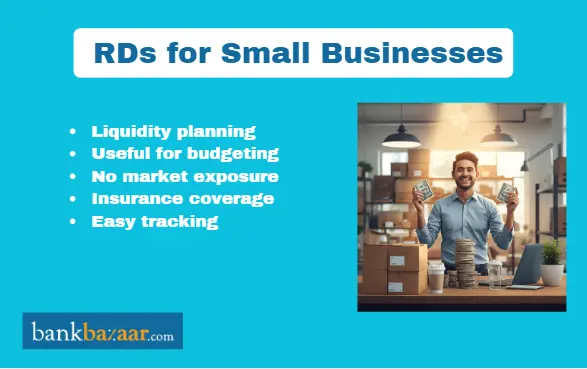
Use Cases of RDs for Small Enterprises
- Setting aside money for annual expenses like GST or income tax
- Saving for new equipment or office upgrades
- Creating an emergency fund for business downtime
- Building working capital gradually without taking a loan
- Preparing for seasonal inventory purchases
Example: RD in Action for a Small Business
Let’s say a small business sets up an RD of ₹10,000/month for 2 years at 7% interest compounded quarterly.
- Total deposits: ₹2,40,000
- Maturity amount: Approx. ₹2,52,000
- Interest earned: ₹12,000 (approx.)
This disciplined saving approach allows businesses to build a financial buffer without taking risks.
How to Open an RD for Your Business
Steps typically include:
- Choose a bank offering competitive RD rates
- Provide business PAN, address proof, and GST registration (if applicable)
- Link to your business current account
- Set standing instructions for auto-debit
Note: Some banks allow opening RDs through internet banking or mobile apps under the business account.
Choosing the Right RD Plan for Your Business
When selecting an RD, small businesses should consider the following:
Key Factors to Compare Across Banks:
- Interest Rate: Higher rates mean better growth, especially over long tenures
- Compounding Frequency: Most banks use quarterly, which is ideal
- Tenure Flexibility: Choose a plan that matches your financial timeline
- Premature Withdrawal Terms: Look for minimal penalties
- Minimum Monthly Deposit Requirement: Ensure it fits your cash flow
- Digital Access: Prefer banks offering online management and tracking
Tip: Compare offerings from public banks, private banks, and small finance banks.
How to Automate Your Business RD
Automation ensures that your business doesn't miss a monthly installment. You can set up:
- Standing Instructions (SI) from your business current account
- Scheduled bank transfers via net banking
- RD setup via banking APIs or ERP integrations (for digitally enabled businesses)
This helps maintain financial discipline and avoids penalties for missed payments.
Safety & Security of RD Investments
Recurring Deposits are among the safest investment options available to small businesses. Here’s why:
- Offered by regulated financial institutions (RBI-governed)
- Capital protection is guaranteed
- Covered under DICGC insurance (up to ₹5 lakh, including interest) in most cases
- No exposure to market volatility
Suitable for conservative business owners looking to protect their capital while earning interest.
How RDs Fit Into Business Budgeting
You can integrate RDs directly into your monthly budget using this approach:
- Treat RD payment as a fixed business expense
- Categorize it under “Capital Reserves” or “Future Expense Fund”
- Use the maturity for cash outflows like insurance renewals, loan repayments, or equipment upgrades
This reduces the reliance on emergency loans or high-interest credit options.
Strategic RD Planning: Laddering Approach
Small businesses can use the RD laddering technique to manage liquidity and return:
How it works:
- Open multiple RDs with staggered maturities (e.g., 6, 12, 18, and 24 months)
- Each RD matures at different intervals, giving you periodic liquidity
- Reinvest matured funds or use them for business needs
Benefit: Ensures regular access to funds without breaking long-term RDs prematurely.
RD Accounting Tips for Small Businesses
Here’s how to handle RDs in your books:
- Monthly RD deposits: Record as a “Current Asset” (under investments)
- Interest earned: Recognize under “Other Income” or “Finance Income”
- At maturity: Transfer total proceeds (principal + interest) to your current account
- Use accounting tools like Tally, Zoho Books, QuickBooks, etc., to track and reconcile
Ideal Industries for RD Use in Small Business
RDs can be especially useful for these sectors:
- Retailers: Saving for seasonal stock or rent
- Freelancers/Consultants: Creating a tax reserve fund
- Home-based businesses: Saving to scale operations
- Traders: Managing cash surplus during off-seasons
- Boutique agencies: Planning for software licenses, domain renewals, or client events
Taxation on RD for Businesses
- Interest earned is taxable as business income
- TDS applies if interest exceeds ₹40,000/year (₹50,000 for senior citizens – not applicable to businesses)
- Must be reported in ITR under ‘Income from Other Sources’ or P&L depending on accounting method
Tips for Maximizing RD Benefits
- Choose a longer tenure to maximize compounding benefits
- Open multiple RDs for different goals
- Compare interest rates across banks (private, public, and small finance banks)
- Avoid premature withdrawals to retain full interest
- Schedule auto-debit to avoid missed payments


FAQs on Recurring Deposit for Small Businesses
- Can small businesses open a recurring deposit?
Yes. Most banks allow small businesses to open RDs under their business current or savings account.
- Is the interest earned on RDs taxable for businesses?
Yes. RD interest is taxable as business income and must be reported while filing returns.
- What is the ideal tenure for a small business RD?
Tenure depends on your goal. For tax savings or short-term plans, 1–2 years is common. Longer tenures give better returns.
- Can a business break an RD before maturity?
Yes, but premature withdrawal may result in lower interest and penalty charges.
- Do RDs help with business cash flow planning?
Absolutely. They allow businesses to set aside funds regularly and use them for future planned expenses.

Disclaimer
Credit Card:
Credit Score:
Personal Loan:
Home Loan:
Fixed Deposit:


Copyright © 2026 BankBazaar.com.