


Top Mistakes to Avoid While Investing in Recurring Deposits
Recurring Deposits are simple and reliable tools, but ignoring key rules, timelines, or tax implications can erode your returns. Avoiding these mistakes can help you maximize the power of compounding, align your savings with your life goals, and build a solid financial foundation with discipline. With smart planning RDs can be a powerful part of your short and medium - term savings journey.

Recurring Deposits (RDs) are a popular savings option in India, offering disciplined monthly investing with guaranteed returns. While they are considered safe and reliable, many investors unknowingly make mistakes that reduce returns or cause premature withdrawals.
This guide will help you understand the top mistakes to avoid when investing in RDs and how to make the most of this savings instrument.
Common Mistakes to Avoid in Recurring Deposit Investments
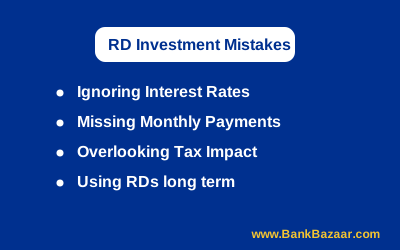
1. Ignoring the Interest Rate Structure
Many investors assume all banks offer the same RD interest rates. In reality, rates vary widely between banks and financial institutions. Failing to compare rates can result in lower returns over time.
Tip: Always check and compare the latest RD interest rates across top banks before investing.
2. Not Considering the Tenure Wisely
Choosing an inappropriate tenure can either lock your funds too long or cause you to reinvest too often. A mismatched tenure can misalign with your financial goals.
Tip: Match RD tenure with your goal timelines — such as 1 year for short-term purchases or 3–5 years for medium-term goals.
3. Missing Monthly Installments
Missing even a single RD installment could result in penalties, interest loss, or premature closure. Banks usually charge a fee and may adjust maturity amounts for missed payments.
Tip: Set up automated payments (standing instructions or auto-debit) to avoid missing installments.
4. Overlooking Premature Withdrawal Rules
Some investors withdraw their RD early due to emergencies, unaware that premature withdrawals usually come with reduced interest and penalties.
Tip: Build an emergency fund separately and treat your RD as a locked-in goal-based investment.
5. Not Checking for Senior Citizen Benefits
If you or your parents are eligible, not claiming the senior citizen rate means losing out on additional interest (typically 0.25% to 0.75% more).
Tip: Declare the correct age group during RD creation to avail senior citizen benefits.
6. Forgetting to Renew or Reinvest Wisely
At maturity, if you forget to reinvest or withdraw, the RD amount may stay idle in a savings account with lower interest.
Tip: Set reminders to reinvest in a new RD or transfer to a better investment option.
7. Ignoring Taxation on RD Interest
RD interest is fully taxable under “Income from Other Sources.” Many investors overlook this during tax planning and end up with unexpected tax liabilities.
Tip: Factor in TDS and income tax when planning your returns. Consider submitting Form 15G/15H if eligible.
8. Not Reading Terms & Conditions
Many people skip the fine print while opening RDs, especially with online platforms. This can lead to confusion around maturity rules, penalties, or auto-renewal clauses.
Tip: Read all RD terms or ask bank officials before opening an account.
9. Using RDs for Long-Term Wealth Building
RDs are great for short- to medium-term savings. But relying solely on RDs for long-term goals (like retirement) can lead to inflation-beating losses.
Tip: Combine RDs with diversified options like mutual funds, PPF, or NPS for long-term wealth creation.
10. Neglecting Inflation Impact
RDs offer fixed returns, but inflation eats into real returns. Many investors overestimate the growth potential of RDs.
Tip: Use RDs for stability, not aggressive growth. Balance them with growth-focused investments.
Psychological Mistakes Investors Make with RDs
1. Assuming RDs Are “Set and Forget” Investments
Many investors assume RDs require no attention after setup. However, interest rates can change, and better opportunities may emerge.
Tip: Review your RD portfolio every 6–12 months, especially when RBI policy or bank rates change.
2. Following the Herd
Opening an RD at the same bank where you have a salary account—without checking if it's offering the best rate—is a missed opportunity.
Tip: Prioritize returns and flexibility over convenience when selecting an RD provider.
Tax Planning Tips for RD Investors
- RD interest is taxed annually, even if the RD hasn’t matured.
- TDS is deducted only if total interest exceeds threshold, but you're still liable to pay tax on entire interest income.
- Submitting Form 15G/15H (if eligible) can help avoid TDS.
- Keep a record of RD interest across all banks for ITR filing.
How to Maximize Returns from Your RD
- Compare RD rates regularly
- Choose optimal tenure
- Avoid early withdrawals
- Invest consistently and on time
- Use RD calculators to plan
- Plan taxes on RD interest
How to Make Your RD Inflation-Resistant
- RDs provide guaranteed returns, but they may not beat inflation. Here’s how to make the best of it:
- Opt for short-to-medium tenures (1–3 years) instead of locking in low rates long-term.
- Reinvest RD maturity into higher-yield instruments.
- Consider laddering multiple RDs to manage reinvestment risk and interest rate changes.
Key Takeaways
- Avoiding common RD mistakes ensures better returns and fewer penalties.
- Always align RDs with specific financial goals.
- Tax, tenure, and timely payments play a crucial role in RD success.
- Read the terms carefully and use automation to stay on track.


FAQs on Mistakes to Avoid When Investing in Recurring Deposits
- Is there a penalty for missing RD installments?
Yes, most banks charge a small penalty for missed RD payments, and it can affect the maturity value.
- Can I close my RD before maturity?
Yes, but it often results in lower interest and penalty charges. Only use premature withdrawal for emergencies.
- Are RD returns taxable?
Yes, RD interest is fully taxable as per your income slab. TDS is applicable if interest exceeds ₹40,000 (₹50,000 for senior citizens) in a financial year.
- Is an RD better than a Fixed Deposit (FD)?
RDs are good for monthly savers while FDs suit lump sum investments. Both offer similar interest rates but serve different purposes.
- What happens if I forget to renew my RD?
Your RD amount may move to a savings account at a lower interest rate. Some banks offer auto-renewal, but always verify this beforehand.

Disclaimer
Credit Card:
Credit Score:
Personal Loan:
Home Loan:
Fixed Deposit:


Copyright © 2026 BankBazaar.com.