


Lowest Interest Rate on Education Loan
The lowest interest rate on an education loan currently starts around 6.90% p.a. under the government's PM-Vidyalaxmi scheme, with most banks pricing education loans between 7% and 13% p.a. depending on the course, institute, security and applicant profile. Bank of Baroda, SBI, ICICI Bank, Central Bank of India, Bank of India and PNB each offer such loans.

So, students have to go through the list to check if the courses or institutions are included in it. There are various banks that offer education loans with low interest rates. Students can compare these and finally choose the one which matches their needs.
Best Education Loans with Lowest Interest Rates
The following are the banks which are currently providing education loans with the lowest rate of interest:
Bank of Baroda Education Loan Interest Rates
Bank of Baroda provides a wide range of education loans with a low rate of interest. The maximum amount offered depends on the type of loan chosen by the student. Here’s is the list of the education loan offered by the Bank of Baroda:
Scheme | Floating Interest Rate | Fixed Interest Rate |
Baroda Vidya | BRLLR + 3.10% p.a. | Floating BRLLR-linked rate. |
Baroda Gyan | BRLLR + 2.00% p.a. (up to Rs.7.50 lakh) to BRLLR + 1.90% p.a. (above Rs.7.50 lakh) | Base Rate + 2.00% p.a. (up to Rs.7.50 lakh) to BRLLR + 3.90% p.a. (above Rs.7.50 lakh) |
Baroda Education Loan to Students of Premier Institutions (For Studies in India) | BRLLR – 1.05% p.a. (top 10 IIMs/IITs) to BRLLR + 0.50% p.a. (Category C institutes) | BRLLR + 1.40% p.a. to BRLLR + 3.05% p.a., depending on institute category |
Baroda Scholar | BRLLR + 0.55% p.a. (premier institutes, studies abroad) to BRLLR + 2.00% p.a. (non-premier, up to Rs.7.50 lakh) | Base Rate + 2.00% p.a. to BRLLR + 3.05% p.a., depending on institute category and loan amount |
Baroda Skill Loan Scheme | BRLLR + 1.50% p.a. (flat, all loan amounts) | Contact the bank |
- Processing fee: Nil.
- Security: Available.
- Co-borrowers: Parents or guardians can be co-borrowers.
- Margin: 5% for loan above INR 4 lakh.
- Concession: Female applicants get up to 0.50% concession on their return on investment.
SBI Education Loan Interest Rate Comparison
State Bank of India (SBI) provides a wide range of education loans with interest rates starting from 6.90% and flexible repayment tenures. Education loans can be availed by students both for studies in India and abroad. SBI also offers loans to students to pursue vocational training and other professional courses.
Let us have a look at the table given below to know the interest rates charged by SBI on different education loans:
Education Loan Schemes | Interest Rates (p.a.) |
SBI Scholar Loan Takeover (formerly Take Over of Education Loan) | 6.90% p.a. to 7.65% p.a., for loans above Rs.10 lakh |
SBI Global ED-VANTAGE | 8.90% p.a. to 9.40% p.a. (with collateral) / 9.40% p.a. (without collateral) |
SBI Scholar Loan | 6.90% p.a. to 7.65% p.a., for select premier institutions |
SBI Student Loan | 9.40% p.a. (with collateral, above Rs.7.50 lakh) to 9.90% p.a. (without collateral, up to Rs.7.50 lakh) |
SBI Skill Loan | 9.40% p.a. |
SBI Features
- Processing fee: For studies on foreign shores, up to Rs. 10,000. For all loans above Rs. 20 lakh, similar charges are applicable. Loan schemes for scholars, skill upgradation, and takeover of education loans from other banks will not be charged any processing fees.
- Security: On loans above Rs. 7.5 lakh, tangible collateral security is required.
- Co-borrower: Parents or guardians can be co-borrowers.
- Collateral: This applies only to takeover of education loans.
- Concession: Girl applicants get up to 0.50% concession on their return on investment.
ICICI Bank Education Loan Interest Rate
Individuals aged between 18 and 35 are eligible for ICICI Bank's education loans, subject to their academic progress, GPA score, and confirmation of admission to recognized institutions in India or overseas.
A parent or guardian serves as the co-applicant and is required to provide tangible collateral as security, with specifics dependent on the course, loan amount, and source of income. These loans typically feature competitive and low-interest rates.
Education Loan Scheme | Interest (%) |
Education Loan | 8.50% p.a. to 13.00% p.a. |
ICICI Bank prices its education loan by course and security offered: loans for studies abroad start from 9.00% p.a. (secured) or 10.25% p.a. (unsecured), while select domestic institutes start from 8.50% p.a. (secured) or 9.25% p.a. (unsecured).
ICICI Bank Features
- Processing fee: Up to 2%.
- Security: Fixed deposit, property value, and up on existing loans.
- Co-borrowers: Parents or guardians can be co-borrowers Margin: Nil for premier institutes, and up to INR 20 lakh for others. Accepted in the form of FD, and scholarship or initial fee paid to the institute.
- Concession: I-smart education loans for studies in Canada come with lower rates.
Bank of India Education Loan Interest Rate
Bank of India offers a wide range of education loan schemes to students who wish to pursue higher studies in India and abroad. The loans will be provided on the basis of the earning potential of students after completing the courses.
Education loan scheme | Interest Rate (%) |
Star Education Loan – India | RBLR + 1.70% p.a. (up to Rs.7.50 lakh) to RBLR + 2.50% p.a. (above Rs.7.50 lakh) |
Star Education Loan – Abroad | RBLR + 1.70% p.a. (up to Rs.7.50 lakh) to RBLR + 2.50% p.a. (above Rs.7.50 lakh) |
Star Vidya Loan | 9.25% p.a. onwards |
Star Progressive Education Loan | RBLR + 1.70% p.a. |
- Processing fee: Nil.
- Security: NA
- Co-borrowers: Parents or guardians.
- Margin: Nil on loans to INR 4 lakh
- Concession: Up to 1% concession on RoI to female borrowers, and all students pursuing professional courses.Bank of India
PNB Education Loan Interest Rate
Punjab National Bank (PNB) provides several types of education loans to students with attractive interest rates and repayment tenures of up to 15 years. The students who are planning to pursue their higher education in India, abroad, or at premier institutions are eligible to apply for education loans from Punjab National Bank.
- Processing fee: For studies at foreign institutions, the processing fee will be up to 1%.
- Security: In the case of loans applied for overseas studies, tangible collateral security is required.
- Co-borrower: Parents or guardians can be co-borrowers.
- Concession: Girl applicants get up to 0.50% concession on their return on investment. Students with disabilities are also eligible for concessions.
Education Loan Eligibility
Students should have a look at the following eligibility criteria before applying for education loans:
Courses Covered Under Low‑Interest Education Loans
Students can apply for education loans for the following courses:
- Professional certification courses
- Vocational training
- Undergraduate courses
- Postgraduate courses
- PhDs and Doctorate courses
- Job-oriented courses
Nationality Criteria for Education Loan Eligibility
Students who are planning to apply for education loans should be
- Indian citizens
- Persons of Indian Origin (PIO)
- Non-Resident Indians (NRIs)
- Overseas Citizens of India (OCI)
Institutes Eligible for Low-Interest Education Loans
Banks provide education loans to the following:
- Government colleges
- Recognized Universities
- Private institutions
- International universities and colleges
Documents Required for Education Loan Application
Students have to submit scanned copies of the following documents to get education loans from banks:
- Admission letter from the college or university
- Marksheets of Std.10, Std.12, and graduation
- Permanent Account Number (PAN) card
- Aadhar card
- Passport
- Voter ID card
- Bank passbook
- Salary slips of the co-applicant
- Income Tax Returns for the last two years of the co-applicant
- Two passport size photographs
Points to Consider Before Applying for an Education Loan
- Government schemes like CGFSEL, Dr. Ambedkar Central Scheme, and Padho Pardesh Scheme provide interest subsidies
- The Pradhan Mantri Vidyalaxmi Yojana is now offered alongside these schemes by several lenders, including SBI, Bank of Baroda, Central Bank of India and PNB (institute-specific rates from around 7.50% p.a. at PNB), and can lower the interest rate on an eligible education loan further
- Reserve Bank of India rules require lenders to sanction an education loan of up to Rs.7.50 lakh without collateral or a third-party guarantee, as reflected in several banks' loan terms above
- Tax exemptions available under Section 80E
- Some banks charge additional 0.05% risk premium if borrower lacks credit life insurance
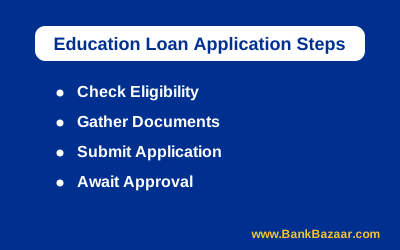
Application Process: Students can apply online (filling form and uploading documents) or offline (visiting bank branch with physical form and documents).
Summary
Bank of Baroda, SBI, ICICI Bank, Central Bank of India, Bank of India and PNB each price education loans differently by course, institute and security offered, so the lowest interest rate on an education loan varies by lender and applicant profile. Comparing the schemes above, along with any government interest subsidy you qualify for, is the most reliable way to find the lowest interest rate on an education loan. Confirm the current rate directly with the chosen bank before applying, since education loan pricing is revised periodically.
FAQs on Lowest Interest Rate on Education Loan
1.What is the lowest interest rate on an education loan?
The lowest interest rate on an education loan depends on the lender, the specific scheme, the course and institute, and whether the applicant offers collateral. Government-backed subsidy schemes and premier-institute schemes typically offer the lowest interest rate on an education loan among the options above.
2.What does an education loan include?
An education loan covers tuition fees, examination fees, hostel or accommodation charges, and travel and book expenses linked to the course. It can also fund project work and other study-related costs at the lender's discretion.
3.Can I get an interest-free education loan?
No bank in India offers a fully interest-free education loan, since an education loan carries the same credit risk as other retail loans for the lender. Certain government schemes provide an interest subsidy during the study period, which can reduce the effective cost of an education loan without making it interest-free.
4.Who is eligible for an education loan?
Indian citizens, Persons of Indian Origin, Non-Resident Indians and Overseas Citizens of India can apply for an education loan, subject to the lender's course and institute criteria. Most lenders also require a parent or guardian to join as a co-applicant.
5.Which courses are covered under an education loan?
An education loan typically covers professional certification courses, vocational training, undergraduate and postgraduate degrees, PhDs and other doctorate programmes, and job-oriented courses. Coverage varies slightly by lender and scheme.
6.Which institutes are recognised for a low-interest education loan?
Government colleges, recognised universities, private institutions and international universities and colleges are generally recognised for an education loan. Lenders often price an education loan lower for admissions to premier or listed institutes.
7.What documents are required to apply for an education loan?
An education loan application typically needs the admission letter, academic marksheets, identity documents such as PAN and Aadhaar, passport, bank passbook, the co-applicant's income proof, and recent photographs. Exact document requirements can vary by lender.
8.Is collateral required for an education loan?
Collateral requirements for an education loan depend on the loan amount, the institute and the lender's policy, with many banks waiving collateral for smaller loans or premier institutes. Above the lender's no-collateral threshold, security such as property or a fixed deposit is usually required.
9.Who can be a co-applicant for an education loan?
A parent or guardian is the usual co-applicant for an education loan, and some lenders also accept a spouse or other close relative. The co-applicant's income and creditworthiness can affect the interest rate and loan amount sanctioned.
10.Are there tax benefits on an education loan?
Yes, interest paid on an education loan qualifies for a deduction under Section 80E of the Income Tax Act. This benefit applies only to the interest portion and for a limited number of assessment years, so check current tax rules before claiming it.
11.Is there a government subsidy scheme for education loans?
Yes, government schemes such as the Credit Guarantee Fund Scheme for Education Loans, the Dr. Ambedkar Central Scheme, the Padho Pardesh Scheme and the Pradhan Mantri Vidyalaxmi Yojana can lower the effective interest rate on an eligible education loan. Eligibility depends on income, course and institute category.
12.How do I apply for an education loan?
You can apply for an education loan online by filling in the lender's form and uploading the required documents, or offline by visiting a bank branch with the physical form and documents. Processing time varies by lender and by how quickly documents are verified.
13.When does repayment of an education loan begin?
Repayment of an education loan usually begins after a moratorium period covering the course duration plus a few months to a year, giving the borrower time to secure employment. Interest can still accrue during this moratorium unless serviced along the way.
14.What happens if a student discontinues the course after taking an education loan?
If a student discontinues the course, the education loan does not stop being repayable, and repayment must begin once the student takes up suitable employment within the agreed grace period. Lenders assess such cases individually based on the loan agreement.
15.How can I get the lowest interest rate on my education loan?
You can work towards the lowest interest rate on an education loan by choosing a premier institute where eligible, offering collateral where the lender allows it, applying under an available government subsidy scheme, and comparing schemes across lenders before applying. A strong co-applicant profile can also help secure a better rate.

Disclaimer
Credit Card:
Credit Score:
Personal Loan:
Home Loan:
Fixed Deposit:


Copyright © 2026 BankBazaar.com.