


Weakest Currencies in the World In 2026
The Lebanese Pound is considered the world's weakest currency by official exchange rate, primarily due to high inflation, a banking crisis, and political instability. Despite having a service-based industry, these challenges have severely devalued its currency over time. As of October 2026, 1 Indian Rupee is approximately equal to 931-948 Lebanese Pounds.

While strong currencies are usually well-known, the lowest-valued ones often go unnoticed. Understanding the weakest currencies provides insights into global economic conditions and financial stability.
List of the Top Cheapest Currencies in the World for 2026
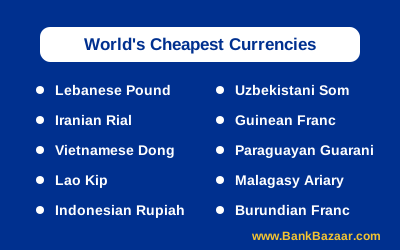
A list of the world’s least valuable currency is mentioned below - As of October, 2026
Currency | 1 INR Value |
Lebanese Pound | 943.20 LBP |
Iranian Rial | 440.3 IRR |
Vietnamese Dong | 272.25 VND |
Lao/Laotian Kip | 237.08 LAK |
Indonesian Rupiah | 190.50 IDR |
Uzbekistani Som | 125.43 UZS |
Guinean Franc | 93.23 GNF |
Paraguayan Guarani | 60.40 PYG |
Malagasy Ariary | 47.77 MGA |
Burundian Franc | 31.60 BIF |
Exchange rates are indicative and may vary based on market fluctuations.
1. Lebanese Pound (LBP)
1 Indian Rupee = 943.20 LBP
The Lebanese pound is currently the weakest currency in the world. Lebanon borders the Mediterranean, Syria, and Israel in the Middle East, and runs a largely service-based economy and exports metals, chemical products, and precious stones. Its currency's collapse stems from political unrest, high inflation, and unemployment following the country's 2019 banking crisis.
2. Iranian Rial (IRR)
1 Indian Rupee = 440.3 IRR
The Iranian Rial is considered the world's second least valuable currency. This is the result of factors like political unrest in the country. The Iran-Iraq war and the nuclear program have also played a huge part in its continued devaluation.
3. Vietnamese Dong (VND)
1 Indian Rupee = 272.25 VND
Vietnam has historically operated under a centralized economy. Although the country has begun establishing a market economy, there is still a long way to go. Currently, there is a significant devaluation of the Vietnamese Dong compared to global standards.
4. Lao/Laotian Kip (LAK)
1 Indian Rupee = 237.08 LAK
The Lao currency has not devalued significantly; since its establishment in 1952, it has maintained a low rate. Buying one US Dollar costs approximately 21,663 Laotian Kip. On the plus side, the currency's circulation value has increased over time.
5. Indonesian Rupiah (IDR)
1 Indian Rupee = 190.50 IDR
The Indonesian Rupiah has seen little improvement over the past seven years. Its depreciation is linked to several issues, including declining foreign exchange reserves due to the central bank's challenges in safeguarding the currency. Indonesia is heavily reliant on its commodity export industry. Additionally, the currency's value fluctuates with commodity prices. Foreign investors hold a significant portion of Rupiah sovereign bonds, which risks capital flow.
6. Uzbekistani Som (UZS)
1 Indian Rupee = 125.43 UZS
This nation's economy faces challenges, which result in a weak currency. While the economy was impacted by the global pandemic, data indicates that the nation's internal operations have been recovering since late 2022. However, fluctuations in industrial output continue to create uncertainty about the future of the currency.
7. Guinean Franc (GNF)
1 Indian Rupee = 93.23 GNF
The Guinean Franc is the official currency of Guinea. The nation suffers from widespread corruption and political unrest, which has made its currency weak. Year after year, the purchasing power of the currency decreases.
8. Paraguayan Guarani (PYG)
1 Indian Rupee = 60.40 PYG
The PYG is Paraguay's official unit of currency. High inflation, corruption, a high unemployment rate, and a rise in poverty have resulted from past economic challenges. Each of these elements has had a detrimental effect on the currency's value.
9. Malagasy Ariary (MGA)
1 Indian Rupee = 47.77 MGA
The Malagasy Ariary is the currency of Madagascar, an Island country located on the south-eastern coast of Africa. The currency was introduced in 1961 and replaced the franc in 2005. The major exports of Madagascar are cloves, vanilla, and nickel metal.
10. Burundian Franc (BIF)
1 Indian Rupee = 31.60 BIF
The Burundian Franc, the currency of the Republic of Burundi, has been in circulation since 1916. This East African country has a population of 14 million, with coffee and tea as its biggest exports.
Factors that have an impact on Currency Exchange Rates:
The following factors influence the rate of currency exchange:
- Current Account Deficits: A current account deficit occurs when a country imports more than it exports. This creates a higher demand for foreign currencies, reducing demand for the local currency. As a result, the local currency’s value falls.
- Economic Performance: Strong economic performance and political stability attract foreign investment. More investment increases demand for the local currency, raising its value. Stability reduces uncertainty and boosts the currency’s strength.
- Government Debt: High government debt can scare off foreign investors. Concerns about inflation and debt repayment can lead to currency devaluation. An oversupply of the local currency from investors selling off their holdings can further weaken it.
- Inflation and Interest Rates: Inflation measures how quickly prices rise. High inflation often leads to higher interest rates as central banks try to control it. Higher interest rates attract foreign investors, boosting the currency’s value. Low interest rates can increase borrowing and spending, potentially leading to inflation and a weaker currency.
- Recession: During a recession, economic activity slows, and interest rates often drop. Lower interest rates reduce the currency’s attractiveness to investors. This can decrease demand for the currency and weaken its value.
- Speculation: Investors buy currencies they expect to rise in value. Increased demand from speculation can strengthen the currency. If investors expect a currency to fall, they may sell it off, decreasing its value.
- Terms of Trade: Terms of trade compare export prices with import prices. If export prices rise faster than import prices, it improves the terms of trade. This leads to higher revenue and demand for the currency, increasing its value.
FAQs on World’s Weakest Currency in 2026
1.Which is the highest currency in the world?
The highest currency in the world is Kuwaiti Dinar.
2.What determines the exchange rate?
Exchange rates are set by two main systems: fixed and floating. Fixed rates used to be tied to gold or silver. Now, most currencies have floating rates that change based on market conditions and decisions by governments and central banks.
3.Which is the lowest currency in the world?
The lowest currency in the world is the Lebanese Pound..
4.Which is the second most expensive currency in the world?
The second most expensive currency in the world is Bahraini Dinar.
5.Why are exchange rates important?
Exchange rates are important because they show how strong or weak a country's currency is compared to others. This affects trade, investments, and the overall economy, much like how checking your bank balance shows your personal finances.
6.What factors affect the Vietnamese Dong's low value?
The Vietnamese Dong is having difficulty adjusting to a market economy, and investors' hesitation to make capital investments in the nation continues to keep the value of the Dong low.
7.What factors impact the value of a currency?
The value of a currency is impacted by various factors such as recession, interest rates, inflation, political instability, government debt, etc.
8.How do exchange rates impact the economy?
Exchange rates affect how much a country’s exports and imports cost. When a currency weakens, exports become cheaper for other countries, which can increase sales, but imports become more expensive. When a currency strengthens, imports are cheaper, but exports may become pricier for other countries.
9.What happens when exchange rates go up?
When exchange rates go up, your currency gets stronger. This makes things like foreign goods and vacations cheaper. However, it can also make your exports more expensive for other countries, which might reduce sales.

Disclaimer
Credit Card:
Credit Score:
Personal Loan:
Home Loan:
Fixed Deposit:


Copyright © 2026 BankBazaar.com.