


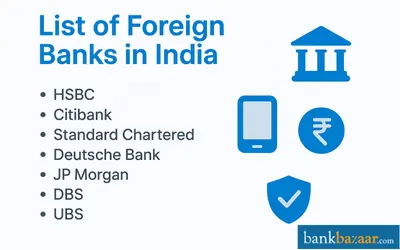
List of Foreign Banks in India
Foreign banks in India are banks headquartered outside India that operate within the country through branches, subsidiaries, or representative offices. These banks bring global expertise, advanced technology, and specialized financial services, especially catering to corporates, NRIs, and high-net-worth individuals.
List of Foreign Banks in India
Bank Name | Country of Origin | Type | Key Services |
Standard Chartered Bank | UK | Branch | Retail banking, corporate banking, trade finance |
HSBC Bank | UK | Subsidiary | Retail banking, NRI services, investment banking |
Citibank | USA | Branch (sold to Axis Bank for retail) | Corporate banking, credit cards, wealth management |
Deutsche Bank | Germany | Branch | Investment banking, corporate finance |
Barclays Bank | UK | Branch | Investment banking, corporate finance |
DBS Bank | Singapore | Branch | Retail banking, corporate banking |
Bank of America | USA | Branch | Corporate banking, treasury services |
JP Morgan Chase | USA | Branch | Investment banking, corporate finance |
Royal Bank of Scotland (RBS) | UK | Branch | Corporate banking, trade finance |
BNP Paribas | France | Branch | Corporate banking, investment services |
Credit Suisse | Switzerland | Branch | Investment banking, private banking |
UBS | Switzerland | Branch | Wealth management, investment banking |
ABN AMRO | Netherlands | Branch | Corporate banking, trade finance |
Societe Generale | France | Branch | Corporate banking, treasury services |
MUFG Bank | Japan | Branch | Corporate banking, trade finance |
Standard Bank | South Africa | Branch | Corporate banking, trade finance |
Sumitomo Mitsui Banking Corporation (SMBC) | Japan | Branch | Corporate banking, trade finance |
ING Bank | Netherlands | Branch | Retail and corporate banking |
Note: Some foreign banks focus primarily on corporate and NRI services, while a few also offer retail banking products.
Benefits of Foreign Banks in India
For Individuals
- Access to global banking products and services
- Advanced digital banking platforms
- Specialized services for NRIs and high-net-worth individuals
For Businesses
- Expertise in trade finance and international transactions
- Access to global capital markets
- Support for cross-border operations
How Foreign Banks Operate in India
- Must register with the Reserve Bank of India (RBI)
- Follow Indian banking regulations, KYC, and anti-money laundering rules
- Offer services such as corporate loans, investment banking, NRI accounts, and selective retail products
- Some operate as branches, while others as subsidiaries or representative offices
FAQs on Foreign Banks in India
- What is a foreign bank in India?
A foreign bank is a bank headquartered outside India that operates in India via branches, subsidiaries, or representative offices.
- How many foreign banks operate in India?
As of 2025, around 40 foreign banks are registered with RBI, with a mix of branches and subsidiaries.
- Can I open a savings account in a foreign bank in India?
Yes, certain foreign banks like HSBC, Standard Chartered, and DBS offer savings accounts, fixed deposits, and credit cards to Indian residents.
- Which foreign banks are most popular in India?
Popular foreign banks include Standard Chartered, HSBC, Citibank, DBS, and Deutsche Bank.

Disclaimer
Credit Card:
Credit Score:
Personal Loan:
Home Loan:
Fixed Deposit:


Copyright © 2026 BankBazaar.com.