


How Credit Cards Affect Your Credit Score
In today's world, it's almost unimaginable to think of life without plastic money, especially credit cards. They provide unmatched convenience and offer financial flexibility, allowing you to make purchases now and pay later. Let’s explore how using a credit card can affect your credit score.
That being said, using your credit card in the right manner is important since the way you use your card has an impact on your CIBIL score. This three-digit number determines your creditworthiness and is used by other lenders as a means of assessing whether or not they should lend to you.
In fact, your CIBIL score plays an important role not only when it comes to the approval of credit products, but also when it comes to availing a favourable rate of interest on those products.
Here’s how your credit card impacts your credit score:
Your Credit Card Repayment History
The one factor that impacts your credit score the most is your card repayment history. This accounts for nearly 35% of your credit score. In order to ensure that you always maintain a good credit score, ensure that you pay your credit card bill on time. Late payments or paying only the minimum amount on your card could adversely affect your credit score.
However, defaulting on your credit card payments will adversely affect your score to a greater extent when compared to late payments. Even one instance of default on your card can bring down your credit score to a large extent.
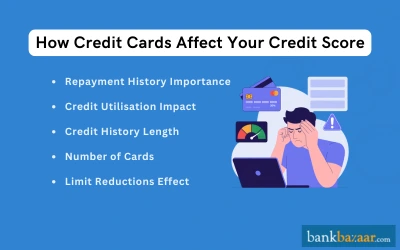
Your Credit Utilisation Ratio
Let’s say that you have two credit cards. Each credit card has a credit limit of Rs.20,000. In total, you have Rs.40,000 worth of credit at your disposal. So, spending Rs.30,000 of this in a single month should be fine, right? After all, you are going to repay the entire amount the following month.
Well, it doesn’t matter if you are going to repay the entire amount the following month because your credit score has already taken a hit since your credit utilisation ratio is higher than recommended.
Confused? Let’s break this down into simple terms.
One of the factors taken into consideration while calculating your CIBIL score is your credit utilisation ratio. This ratio is calculated by taking into consideration your total outstanding debt. dividing it by the total credit that is available to you, and expressed as a percentage. It is advised that your credit utilisation ratio is under 20 to 30%.
In the example provided earlier, your credit utilisation ratio is 75% which is above the recommended percentage. Since this ratio accounts for around 30% of your credit score, you should always keep it as low as possible.
There are two ways to reduce your credit utilisation ratio. They are:
- Request your bank to increase the credit limit on your card. This way, the total amount of credit available to you is increased.
- If you have one credit card, consider applying for another. This, in turn, increases the total amount of credit available to you.
This being said, don’t request for an increase in your credit limit frequently since it could be seen as a sign of being too dependent on credit.
How Long You Have Held a Credit Card
If you have a credit card that you have held for the last 5 years or so and you haven’t been using it much, you probably have considered closing the card account. That may not be the best course of action since the length of your credit history plays an important factor in calculating your credit score.
A long-standing credit card provides more insights into your credit history than one that has been active for a few months. Let’s say that when you first got your credit card, you didn’t know quite how to use it and ended up defaulting on your payments for the first two months. However, you soon realised your mistake and your payments history has been flawless in the following years.
In such cases, a creditor will consider lending to you since they know that your credit behaviour has improved over the years. As such, your CIBIL score will also increase.
Compare this to a credit card which you have held for a few months. Even one lapse in payment could have a huge impact on your CIBIL score.
The Number of Credit Cards in Your Name
While it does make sense to have two credit cards to help increase the amount of credit available to you and reduce your credit utilisation ratio, having too many credit cards could have an adverse effect.
In general, you shouldn’t have more than three active credit cards for two reasons:
- You may not be able to keep track of payments on all the cards. This may lead to a default in payment.
- Too many credit cards, is to a lender, a sign that you are excessively dependent on credit.
At the end of the day, it is important to remember that your CIBIL score is not based only on your credit card usage. The score takes into consideration all credit products. So, a personal loan or a home loan that you have will also impact your CIBIL score.
In order to maintain a good score, always ensure that no matter what credit product you have, you make your repayments on time and use the credit extended to you judiciously. This will increase your CIBIL score and help you in the long run. For all you know, your CIBIL score may be the deciding factor when it comes to your loan getting approved or granting you a lower than advertised rate of interest on a loan.
So, the next time you use your credit card, keep these factors in mind.
If your credit card limit is reduced
Owing to the recent breakout of the COVID-19 virus pandemic, many credit card issuers have reduced the credit card limits on their customer’s credit cards. This has been put into effect considering that there might be a surge in the default ratio. This precautionary measure might work out well on part of the card issuers, but it can prove to be detrimental for the cardholders.
In this regard, it should be kept in mind that the credit bureaus consider the credit card utilisation ratio to be one of the most important factors for calculating credit scores. In fact, the weightage of this factor is taken to be around 20% to 30%. Thus, in such cases, if the credit limit on your credit card is reduced but your expenses do not, your credit utilisation will be higher. If there has been a drastic drop in the credit limit of your credit card, make sure your expenses on that card is also being cut short. If that is not taken care of, it will result in a drop in the cardholder’s credit score.
FAQs on How Credit Cards Affect Your Credit Score
1.Is having multiple credit cards affect your credit score?
No, it does not matter how many credit cards you have. What matters is how you use your credit card which affects your credit score. For instance, if you have two or thirteen credit cards, your credit score will reduce if you fail to pay your credit card bill on time. Having said that, if you pay your credit card bills within the given deadline, your credit score will increase. In fact, having more credit cards means a higher credit limit.
2.How many credit cards is too many?
There is no particular number set by any organization which mentions how many credit cards you can avail in maximum. Instead, you can give primary importance to the benefits as well as the usability of your credit cards before you opt for a new credit card from any organization or bank. You should consider some of the important aspects while applying for a credit card such as credit limit, annual fees, and benefits as long as you maintain the credit utilization low and pay your credit card bill within the billing date. Keeping these factors in mind will immensely increase your credit score.
3.Why is it important to maintain a good credit score?
Maintaining a good credit score will provide you with various benefits. Firstly, it increases your chances of getting a loan request approved. Lending institutions favour borrowers who manage their debts well and reward them with the finest credit card and loan offers. Apart from this, banks offer loans with low-interest rates to those who have a good credit score. Thus, when you eventually want to apply for a credit card, personal loan, or even a home loan, having a good score will be helpful. Always give solid credit history priority.
4.How to maintain a good credit score?
In order to maintain a good credit score, you have to make the timely bill as well as Equated Monthly Instalment (EMI) repayments. It is also advisable to avoid overdue bill payments. In addition, you also have to maintain a favourable credit utilization ratio. Also, you need to avoid making multiple credit inquiries. Inspect your joint, guaranteed, and co-signed accounts every month. A good credit score works really well in improving your financial capability among lenders. This will help you to get the best offers while you are applying for credit.
5.How does repayment history impact your credit score?
Your credit history reveals how consistently you have made on-time repayments of borrowed funds. Your credit score is going to be in a suitable range if you have a history of timely loan or credit card payments.
6.What are the 5Cs of credit?
The 5Cs of credit are Character, Capacity, Capital, Collateral, and Conditions when examining personal or commercial credit applications.
7.What habit `lowers your credit score?
Not paying your bill within time is the most common reason which reduces your credit score.

Prerna Surana is a Finance Content Writer with over three years of experience at Bank Bazaar. She specialises in creating insightful content on Credit Cards, Debit Cards, Taxes, and other BFSI products. Beyond finance, Prerna also writes about non-financial utility products such as Aadhar Card, Voter ID, and Government Certificates.

Disclaimer
Credit Card:
Credit Score:
Personal Loan:
Home Loan:
Fixed Deposit:


Copyright © 2026 BankBazaar.com.